A MicroSaaS product should solve a defined problem for a specific group of users. An implementation stack is secondary to evidence that the workflow is useful and that users will adopt it.
Customer discovery and positioning
- Identify a narrow user group and the task they need to complete.
- Document shortcomings in the current workflow.
- Test the proposed improvement with interviews and prototypes.
- Explain the value proposition without promising guaranteed growth.
Build a focused MVP
A minimum viable product should cover the core task and include a way to collect feedback. Choose dependencies according to requirements and maintenance capacity; using several databases or frameworks does not by itself make a product scalable.
Pricing and distribution
Compare subscription, trial and tiered options with the cost of serving users. Test acquisition channels that fit the audience, such as useful technical content or relevant partnerships. Treat each channel as an experiment.
Operations and support
Define onboarding, support coverage, access controls, backup and incident handling before broad release. Keep the public roadmap realistic and distinguish planned work from committed delivery.
Measure and iterate
Track activation, retention, support effort and operating cost. The earlier trailing-twelve-month revenue and profit figures were not supported by a stated scenario and have been removed. Set targets using actual assumptions and review them as evidence changes.
Define the smallest complete workflow
A MicroSaaS product should solve a specific task from input to accepted result. A small interface is not necessarily a small operating system. Authentication, data persistence, support, updates and recovery still need owners even when the feature set is narrow.
For a hypothetical scheduled-report service, the complete workflow includes selecting an authorized source, configuring a report, executing it, checking the result and notifying the user. Identify which of these steps creates value and which failures would make the product unusable.
Tenancy and access boundaries
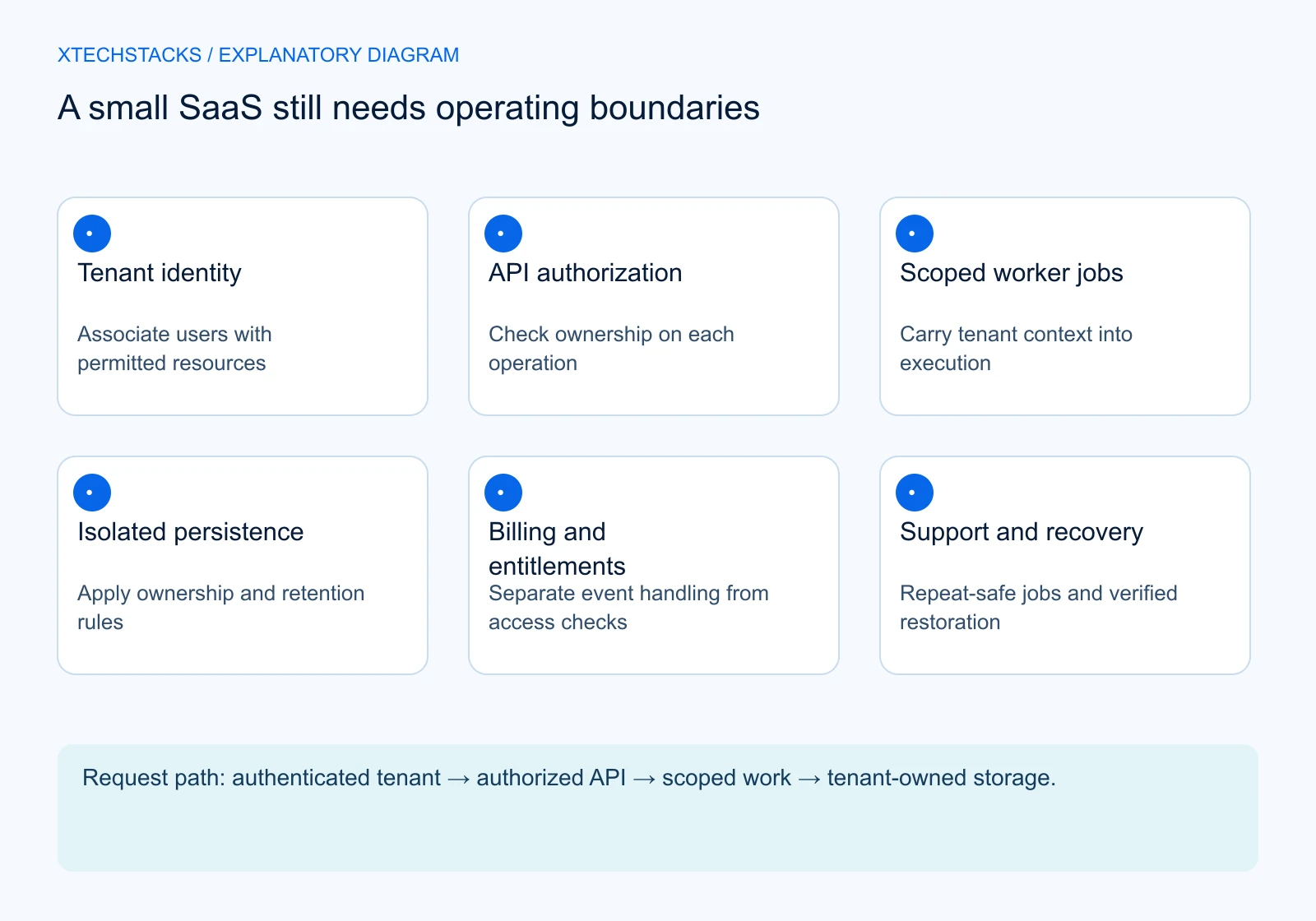
Associate resources with the appropriate account or tenant and enforce ownership in the backend. Do not trust identifiers sent by the browser as proof of access. Test direct requests for another tenant’s report, configuration and output.
Decide whether data is isolated through separate resources or a shared design with enforced boundaries. Each approach has maintenance and cost implications. Document deletion, export and support access so administration does not become an undocumented exception to the permission model.
API, workers and persistence
Keep long-running report execution separate from the request that submits it. A worker can process an identified job and record its state while the interface displays progress. Define retries and ensure that duplicate execution does not create duplicate customer-visible results.
Store accepted output with a stable identity and completion record. A worker returning success is not enough if the result is incomplete or inaccessible. Use explicit validation and a publication step where correctness matters to consumers.
Billing and entitlements
If the product uses a billing integration, treat its notifications as inputs that need validation and repeat-safe handling. Keep an authoritative entitlement model rather than allowing interface state alone to decide access. Payment and subscription events may arrive out of order or be retried.
Do not expose billing or customer secrets in logs or examples. Account cancellation, data retention and access changes need a defined sequence. Separate financial integration from core job execution so a transient billing event does not silently corrupt application data.
A practical first release
The report-service example can start with one source and one output format. The backend validates source access, submits a job and records a candidate result. An acceptance check makes the result available to the requesting account. The interface explains failures without exposing internal secrets.
Test an expired source credential, a duplicate submission, a worker restart and a removed account. These cases reveal the operating boundaries that a happy-path demonstration does not. Keep the example explicitly hypothetical until the behavior is actually implemented and tested.
Operations and support
Track job failures, completion times, service availability and customer-visible errors. Define who receives an alert and how an affected user can continue or recover. Small products still need backups and a tested restoration path for important state.
Support procedures should avoid broad access to customer data. Capture useful diagnostics with sensitive fields removed. Review recurring incidents to decide whether a feature, integration or operating assumption needs to change.
Trade-offs and recommended approach
Managed services can reduce infrastructure work, but create integration and lifecycle obligations. Custom infrastructure can offer control while consuming limited engineering time. Prefer existing reliable capabilities unless a specific requirement justifies replacement.
Build one complete workflow and validate it with intended users. Measure support effort and total operating cost alongside adoption. Do not present recurring revenue, rapid growth or low maintenance as automatic consequences of choosing a small SaaS model.
Key takeaways
- Scope a complete user outcome, not only an interface.
- Enforce tenancy in backend operations.
- Make background jobs and billing events repeat-safe.
- Budget for support, maintenance and recovery.