
Quantum computing is relevant to selected computational problems, not a universal replacement for classical computing. Its potential value depends on the algorithm, hardware quality and workload being compared. An enterprise discussion should separate theoretical capability, experimental evidence and a practical operating decision.
Terms such as qubits and superposition describe important physical concepts, but they do not mean that every possible answer can be read at once. A useful evaluation asks whether a specific problem can be encoded, executed and measured in a way that improves on an appropriate classical baseline.
What changes in the computational model
Classical systems manipulate conventional information through deterministic or probabilistic software operations. Quantum computation uses controlled quantum states and operations. Interference is central to useful quantum algorithms; measurement produces outcomes rather than exposing every internal possibility directly.
The distinction creates opportunities for some algorithms while introducing substantial engineering constraints. Avoid explaining quantum computers as simply faster ordinary computers. The relevant advantage is tied to a problem and algorithm, not a general speed multiplier.
Applications under investigation
Simulation of quantum systems is an important area of research, including problems in chemistry and materials. Certain cryptographic algorithms would be threatened by a sufficiently capable quantum computer. Optimization is also studied, but a useful advantage must be demonstrated against suitable classical approaches.
Do not convert these research directions into promises of immediate business outcomes. A proposed use case needs a defined problem size, comparison method and evidence that the entire workflow is useful. An impressive experiment may not represent a production-ready service.
Hardware and error constraints
Noise, imperfect operations and measurement limitations affect execution. Fault-tolerant computation requires error-management techniques and sufficient reliable resources. Counting physical qubits alone does not establish how much useful computation a system can perform.
Evaluate the assumptions behind a hardware claim. Circuit structure, operation quality and execution requirements matter. A benchmark on one task cannot be generalized automatically to an enterprise workload with different input, output and integration constraints.
The classical system still matters
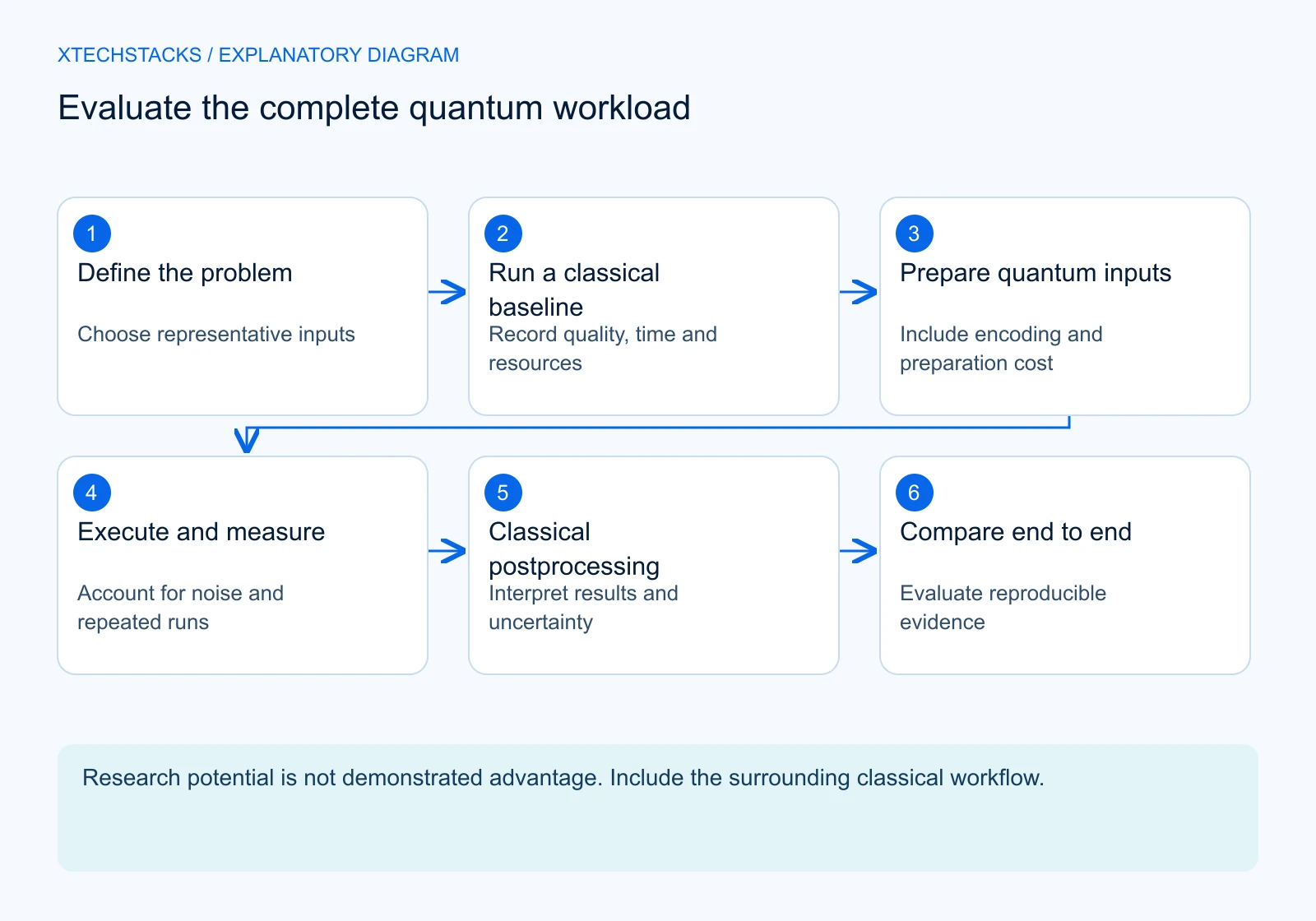
A quantum workflow usually includes classical preparation, orchestration and interpretation. Data encoding, repeated execution and analysis can contribute substantial work. Compare the complete workflow rather than an isolated quantum operation.
Operational concerns such as access, reproducibility, provider dependency and result interpretation remain relevant. A proof of concept should preserve the problem definition, configuration and comparison evidence so another reviewer can understand what was demonstrated.
A hypothetical workload evaluation
Consider a research team evaluating a small chemistry-related problem. It defines the target calculation, chooses a classical reference method and records the quantum algorithm’s assumptions. The comparison includes accuracy requirements, resources and the classical processing surrounding execution.
The team reports where the experiment is informative and where scale or noise limits its conclusions. This is an illustrative evaluation process, not a claim that XTechStacks has demonstrated quantum advantage or delivered a customer quantum system.
Cryptography and readiness
Post-quantum cryptography uses algorithms designed to resist quantum attacks and runs on classical systems. It is different from quantum cryptography. Neither should be described as an unconditional guarantee of unbreakable security.
Organizations can begin with an inventory of cryptographic dependencies and relevant data lifetimes. Follow authoritative migration guidance and vendor support rather than selecting an unfamiliar algorithm from a promotional claim. Transition planning is a concrete engineering activity even while useful quantum hardware continues to develop.
Trade-offs and evidence standards
Exploratory work can build understanding but consumes specialist time and creates interpretation risks. A provider demonstration may support investigation without establishing a production advantage. Keep the experimental question small enough that results can be reviewed against a meaningful baseline.
Document uncertainty and avoid invented dates for commercial readiness. Hardware progress does not translate into a predictable release schedule for every workload. Architecture discussions should state what is known, what is being tested and what would change the decision.
Recommended approach
Separate research exploration from operational commitments. For a proposed computational use case, define the benchmark and acceptance evidence first. For security readiness, inventory existing cryptography and follow established transition guidance through the organization’s normal review process.
Do not purchase complexity merely to signal innovation. A classical solution may remain the appropriate choice. Quantum computing deserves technically precise evaluation, not dismissal or universal promises.
Review the comparison record
A useful review record states the classical method, quantum approach, input scale, accuracy condition and complete execution cost. Include unsuccessful attempts and constraints that prevented a fair comparison. If the experiment changes the problem definition or relaxes accuracy, make that visible. A result is easier to interpret when the comparison conditions are explicit rather than summarized only as a speed claim.
Key takeaways
- Quantum advantage is problem-specific, not a general speed claim.
- Compare complete workflows against suitable classical baselines.
- Account for noise, error correction and integration.
- Keep cryptographic readiness distinct from quantum experimentation.