DataOps applies collaboration, automation, testing and operational discipline to data delivery. The practical objective is not faster movement of arbitrary records. It is repeatable delivery of data that consumers can understand, verify and recover when something goes wrong.
A pipeline can run without an infrastructure error and still produce an incorrect result. DataOps therefore connects software-delivery controls with source contracts, data-quality checks, reconciliation and accountable ownership. The output’s meaning matters as much as the job’s exit status.
Define the data contract
A contract describes fields, units, keys, update semantics and expected freshness. It also identifies the producer and consumers. Record which conditions are guaranteed, which are best-effort and how changes are communicated. A schema alone does not explain business meaning.
For a hypothetical revenue dataset, clarify whether a row represents an order, an invoice or a recognized amount. Specify how cancellations and late corrections appear. Two sources can use the same field name while representing different business events, creating a plausible but incorrect combined report.
Version transformation logic and dependencies
Keep pipeline definitions and transformation code in reviewed version control. Link outputs to the source interval, code revision and configuration. If a rule changes, the team should be able to identify which outputs used the old and new interpretation.
Record dependency versions and execution assumptions. A notebook or manual query may support exploration, but release-critical logic should have a repeatable execution path. Avoid relying on a personal workspace as the only place where the correct transformation can run.
Test at several boundaries
Unit tests check transformation rules on small examples. Contract tests validate source and output shape. Data-quality tests inspect relevant conditions such as missing keys, invalid categories or unexpected duplication. Reconciliation compares the processed result with authoritative input evidence.
Choose checks according to consequences. A fixed row-count threshold may reject legitimate growth while missing a duplicated subgroup. Prefer checks that express the dataset’s meaning, and document where an anomaly requires investigation rather than automatic rejection.
Make retries and replay explicit
Define the processing unit: a partition, event interval, file or another stable identity. Record checkpoints and completion. A safe replay must not accidentally publish duplicate outputs or repeat an irreversible external action.
Separate temporary work from accepted publication. Consumers should be able to distinguish a complete, validated partition from a partially written one. If a pipeline fails, retain enough state to resume or restart deliberately rather than guessing which stage completed.
A practical delivery workflow
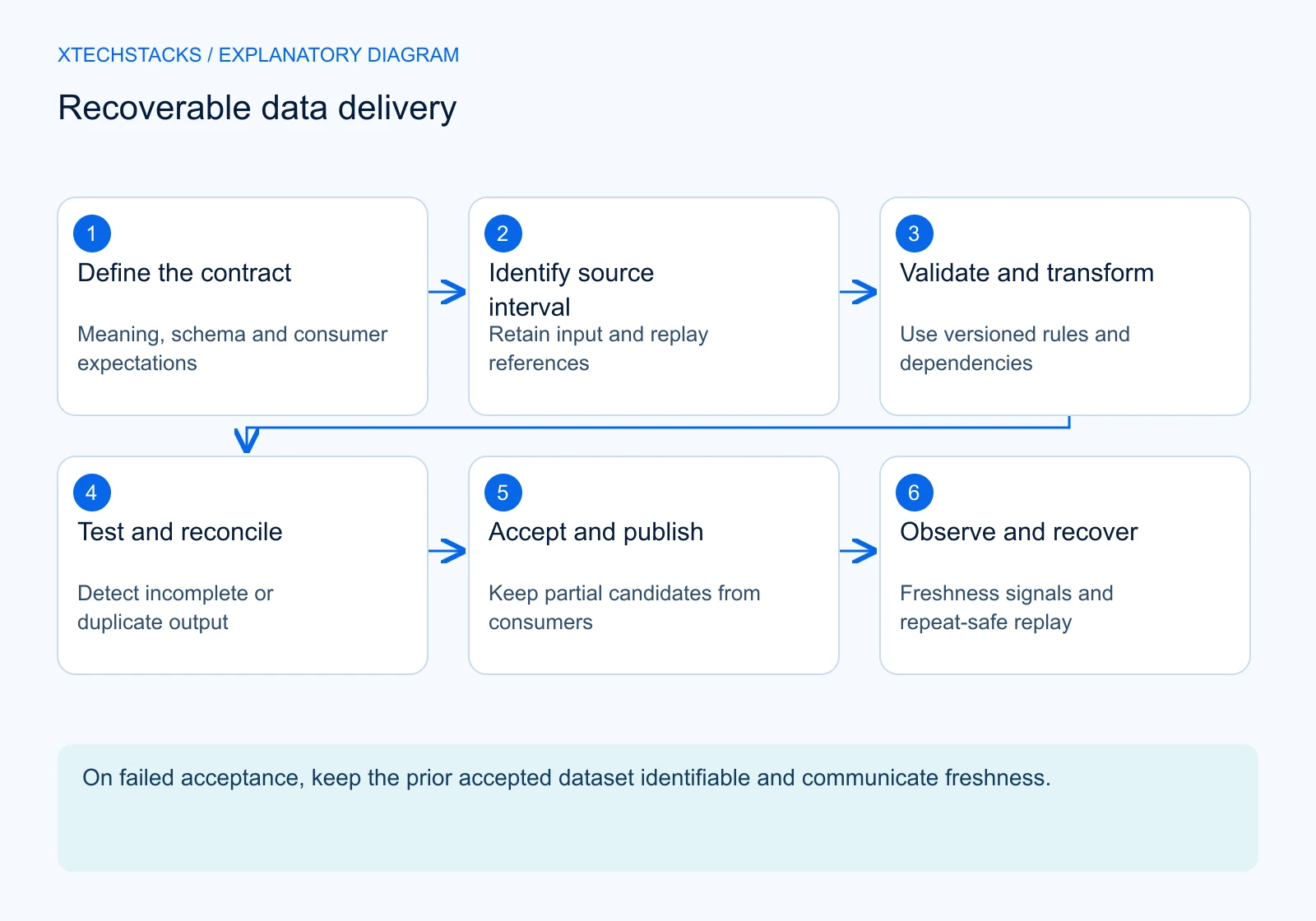
The revenue example captures the approved source interval and validates the contract. A transformation produces a candidate output. Tests check key uniqueness and required fields; reconciliation compares relevant business totals. Only the accepted output becomes visible under the consumer-facing contract.
A late correction creates a controlled replay for the affected interval. The pipeline records the replacement output and its lineage. Consumers can identify the revision instead of seeing a number change without explanation. This is an illustrative operating pattern, not a reported implementation.
Observability and ownership
Monitor freshness, completion, quality failures and reconciliation outcomes alongside infrastructure signals. A green scheduler dashboard does not prove that yesterday’s accepted dataset is still fresh enough for today’s decision. Make stale-data conditions visible to consumers.
Assign an owner to each source and pipeline boundary. An alert should identify the affected dataset, interval, failure condition and first checks. Separate a source-contract change from a platform outage so the response reaches the team capable of correcting it.
Security and retention
Limit source and output access according to the task. Protect credentials through the existing secret mechanism and avoid logging sensitive records during debugging. A test environment should not receive production personal data merely because a pipeline is easier to validate with it.
Retain replay inputs and lineage according to policy. Document the effect of deletions and expiration on recovery. The ability to reproduce an old output is constrained by which source records may lawfully and practically remain available.
Trade-offs and recommended approach
More tests create maintenance work, and poorly chosen checks can generate noise. More historical snapshots create storage and governance obligations. Balance these costs against the impact of incorrect or unrecoverable outputs rather than pursuing universal retention or exhaustive validation.
Start with one important dataset, a clear consumer contract and a tested failure path. Add automation around the actual review and recovery process. DataOps improves engineering when it makes changes and incidents understandable; a collection of tools without ownership does not accomplish that.
Key takeaways
- Test data meaning as well as pipeline execution.
- Version transformations and record source intervals.
- Make accepted publication and replay explicit.
- Give consumers freshness signals and accountable owners.
Test partial publication
Interrupt a controlled pipeline before its acceptance step and inspect the consumer-facing dataset. The incomplete candidate should not appear as an accepted result. Resume or replay the identified processing interval and verify that reconciliation succeeds without duplicate publication. This test exposes failure semantics that ordinary transformation tests may miss.