
ChatGPT is an application built around language models. A useful technical explanation separates text processing, model training and response generation instead of describing them as human understanding.
Tokens and embeddings
A tokenizer converts text into model-specific units and numerical IDs. Tokens may represent whole words, parts of words or other character sequences. An ID is an index, not a ranking of the token’s importance.
Embedding layers map these IDs into numerical vectors. Vector size and tokenization depend on the model. Tokenizer examples must identify the actual model and tokenizer used. A sequence produced for one model should not be presented as verified output from another.
Transformer-based generation
Transformer models use attention and other learned operations to process context. Autoregressive language models generate a sequence by predicting subsequent tokens. Fluent output can still contain incorrect statements.
Training and model comparisons
Pre-training and post-training influence model behavior. Do not assume that every newer model simply has more parameters: OpenAI’s GPT-4 report does not disclose its model size or full architecture.
Similarity is not proof
Cosine similarity compares the direction of two numerical vectors. A high score can be useful in retrieval, but it does not establish that an answer is true or that two texts are interchangeable. Toy vectors are mathematical examples, not evidence of real semantic performance.
Practical limits
Evaluate responses on representative tasks and verify important claims against reliable sources. Context limits, retrieval quality and application controls affect behavior. A conversation does not by itself mean that a hosted model is retraining on each message.
From text to a model request
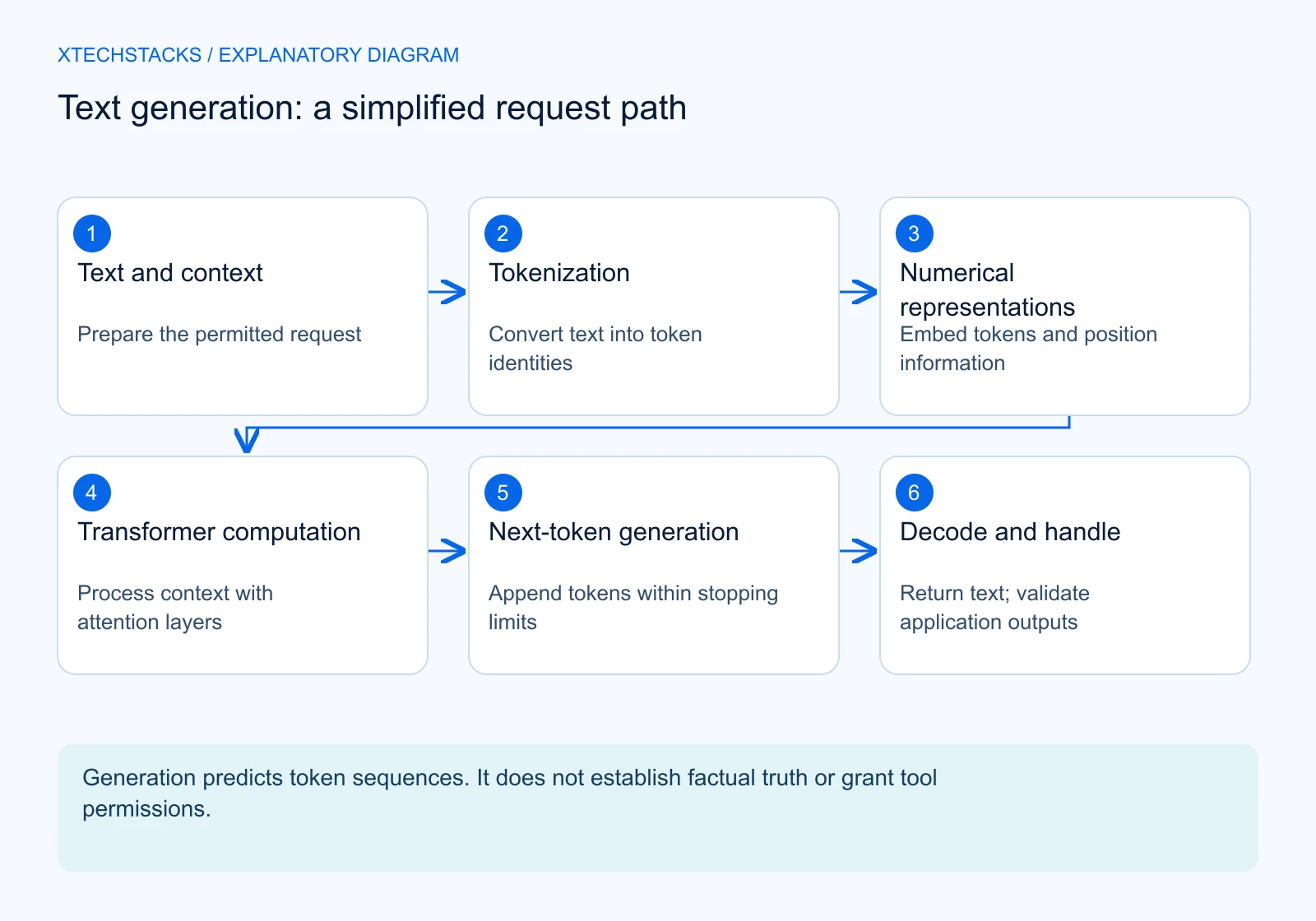
An application prepares messages and supporting context, which are represented as tokens for model processing. Token boundaries do not necessarily match whole words. The available context is finite, so the application must decide which instructions, history and retrieved evidence to include.
A longer context does not guarantee that the model will use every detail correctly. Organize important information and test conflicting or missing evidence. Do not assume that a chat interface exposes all the underlying request preparation, tool execution or provider configuration.
Generation versus authoritative lookup
Autoregressive generation produces a sequence conditioned on the available context. That is different from reading an authoritative record from a database. The result may be useful language while still containing an incorrect name, number or explanation.
For an application answering account questions, obtain the record through a permission-checked system and keep it identifiable. Treat the generated explanation as a separate layer. Verify facts before using them in consequential decisions, and do not mistake confident wording for a validation signal.
Retrieval and embeddings
Embeddings represent inputs numerically for tasks such as similarity search. Retrieval can select passages that help answer a question, but a similarity score is not a truth score. The selected source may be outdated, incomplete or inaccessible to the requesting user.
Evaluate source selection and answer generation separately. Keep citations connected to the actual retrieved material, and define behavior when no supporting passage is available. An answer that invents a plausible citation can look credible while providing no verifiable evidence.
A practical application boundary
Consider a hypothetical engineering documentation assistant. The application establishes user permissions, retrieves approved passages and supplies them with the question. The model prepares an answer, while the interface exposes source references and a route for reporting unsupported output.
Test questions whose answers are absent, questions with conflicting documents and attempts to request unauthorized content. These examples expose integration limits more effectively than a demonstration using only familiar questions. This architecture does not establish that a particular deployed system is reliable.
Tool use and structured output
An application may ask a model to propose a tool call or a structured response. Validate the returned shape and arguments before use. Satisfying a schema does not prove that the values are correct or that an action is authorized.
Keep permissions and consequential approvals outside model wording. Treat user messages and retrieved documents as potentially adversarial input. A generated command should not receive unrestricted execution simply because it is syntactically valid.
Operational trade-offs
Track request latency, errors, usage and application release identity. Protect sensitive prompts and responses in traces. Select evaluation cases representative of the intended task, and compare prompt or model changes against the same baseline.
Hosted model lifecycles and behavior are not entirely under application control. Record the configuration and authoritative model identity available to the client, and document the limits of exact reproduction. Avoid inventing architecture or parameter counts that the provider has not disclosed.
Recommended approach
Use generation where flexible language is useful, and ordinary deterministic code where business rules or exact calculations are required. Start with a bounded task, source-grounded evaluation and clear fallback behavior. Expand only when the evidence supports it.
- Distinguish fluent generation from verified facts.
- Track source selection, model calls and actions separately.
- Validate structured outputs and enforce permissions in code.
- Document provider boundaries and evaluate release changes.