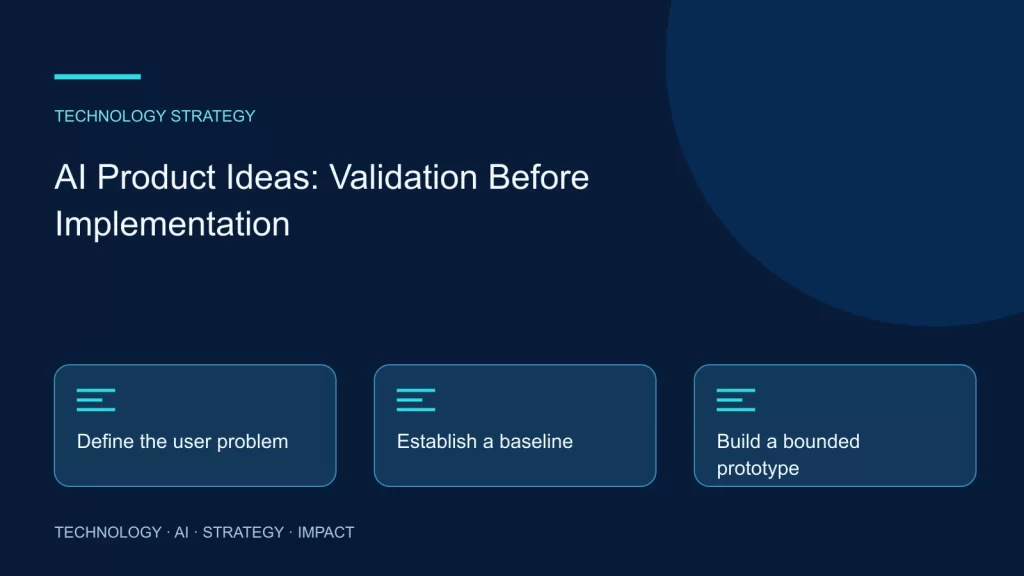
An AI product idea is a starting hypothesis, not evidence of customer demand. Define the task, intended user and measurable benefit before choosing a model or building a platform.
Personalized learning support
A learning platform could adapt practice exercises or recommend approved materials. Validate content accuracy with educators and test whether the workflow helps the intended learners. Define safeguards for student data, especially where minors are involved.
Wellness information support
The original mental-health-assistant proposal requires particular caution. Do not present a general chatbot as a clinician, a diagnostic service or a crisis-response system. Any health-related product needs qualified clinical input, safety evaluation and a review of applicable requirements before release. A disclaimer alone does not establish safety.
Content drafting for marketers
A drafting tool could help organize briefs, propose variations or prepare first drafts. Keep human review for factual accuracy, brand fit and publication. Do not promise higher engagement or search rankings without measured evidence.
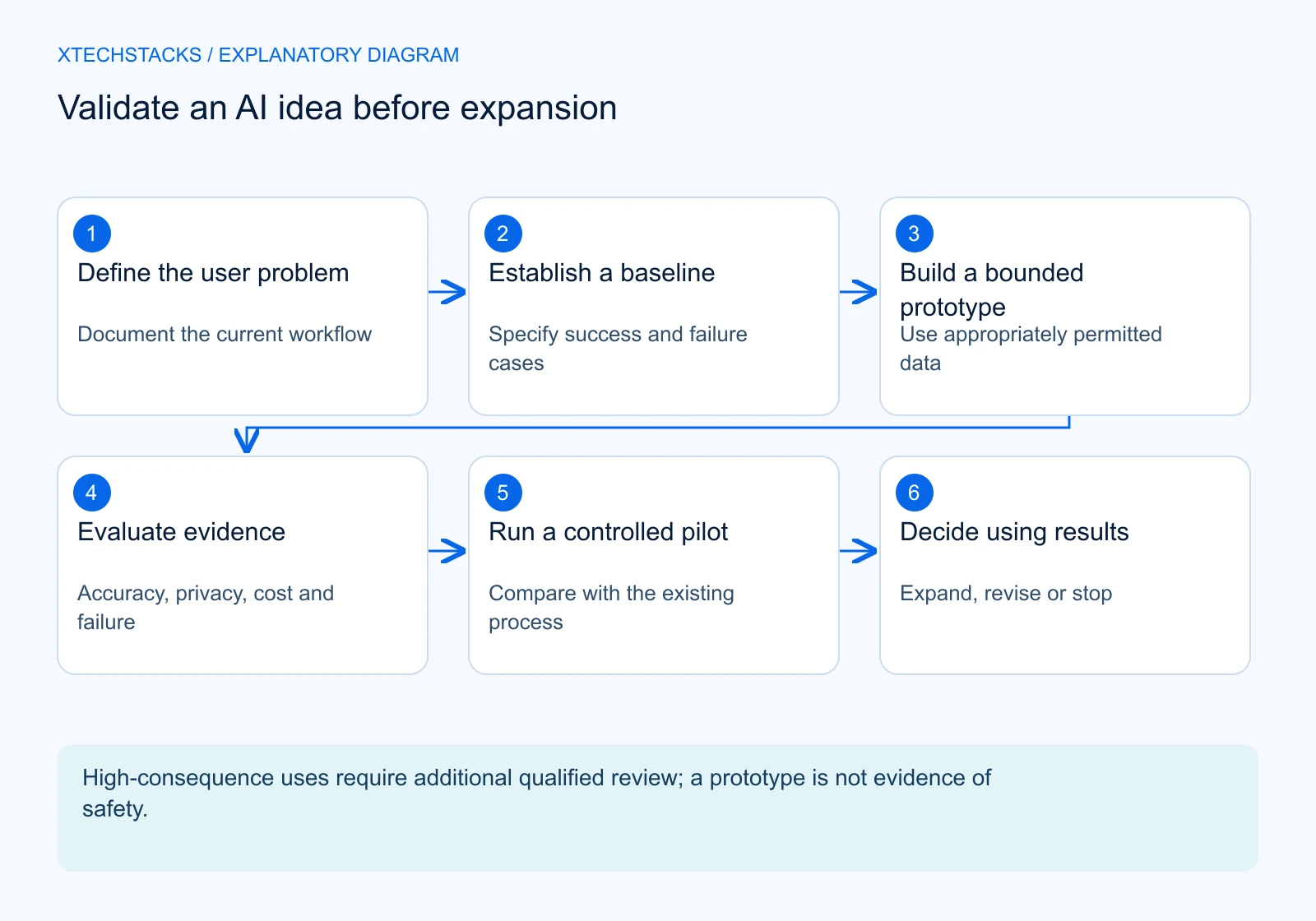
A validation sequence
- Interview intended users and document the current workflow.
- Choose one bounded task and define success and failure cases.
- Build a small prototype with appropriate data permissions.
- Evaluate outputs, privacy risks and operating cost.
- Run a controlled pilot and decide whether the evidence supports expansion.
Choose a problem before an architecture
Product discovery should identify the user’s current task, the cost of failure and the evidence that a proposed change is useful. An idea described as an AI platform may actually need a narrow workflow improvement. Interview users about concrete work rather than asking whether they like artificial intelligence.
For a hypothetical content-brief assistant, the first task might be organizing approved source material into a reviewable draft. That is more testable than promising an entire automated marketing department. Define what remains human-owned and what the tool is not allowed to publish.
Establish a baseline and test set
Record how the task is currently completed and which outcomes matter. Quality, review effort and failure recovery may be more important than generation speed. Build examples from representative work with appropriate permission to use the information.
Include missing inputs, contradictory sources and requests outside scope. A successful demonstration with one carefully chosen prompt is not product validation. Preserve rejected outputs and their reasons so the next iteration addresses real defects.
Separate deterministic work from generation
Use ordinary code for exact rules, access control, calculations and state changes. Use a model where flexible language or uncertain interpretation is appropriate. Keeping these responsibilities separate makes the system easier to test and reduces the chance that a plausible response becomes an unauthorized action.
The brief assistant can retrieve approved facts through explicit source handling and use generation to propose wording. The reviewer verifies the draft before publication. The system should retain the difference between sourced facts and model-generated suggestions.
Data and operating boundaries
Review which inputs may be sent to providers, how traces are retained and who can inspect them. Customer documents can contain sensitive information even in an apparently low-risk writing tool. Define deletion and access procedures before collecting a large evaluation corpus.
Record model and prompt configuration, usage and errors. Provider availability and output variability are operating constraints, not exceptions that can be ignored until after launch. A fallback should let the user finish the essential task without the model.
High-consequence ideas need a different process
Health-related products need qualified domain expertise and a proper safety and requirements review. Do not turn a general prototype into a diagnostic or crisis-response service through branding. A disclaimer does not establish clinical suitability or remove the consequences of incorrect guidance.
Educational products also need context-specific review, particularly where children or sensitive learner records are involved. Keep these concerns visible during discovery rather than treating them as a compliance checkbox added after the interface is built.
Commercial and engineering trade-offs
Estimate the full operating workload: provider usage, retrieval maintenance, human review, support and incident response. Do not assume that a model call replaces the whole task. Interview and pilot evidence should determine whether users value the proposed workflow enough to sustain it.
A narrow product may be easier to explain and validate, but its useful market still needs evidence. A broad feature set can obscure which capability creates value. Test one meaningful task and state the limits honestly before expanding.
Recommended approach
Use staged decisions: problem evidence, bounded prototype, reviewed evaluation, limited pilot and an explicit expansion decision. Define what result would cause the team to stop or change direction. A pilot is useful even when it rejects the initial idea.
- Validate a specific task rather than an AI label.
- Separate generation from exact rules and actions.
- Include human review and provider failure in the design.
- Use observed evidence for product and revenue claims.
Record the pilot’s stopping conditions and the person responsible for enforcing them before collecting user data.