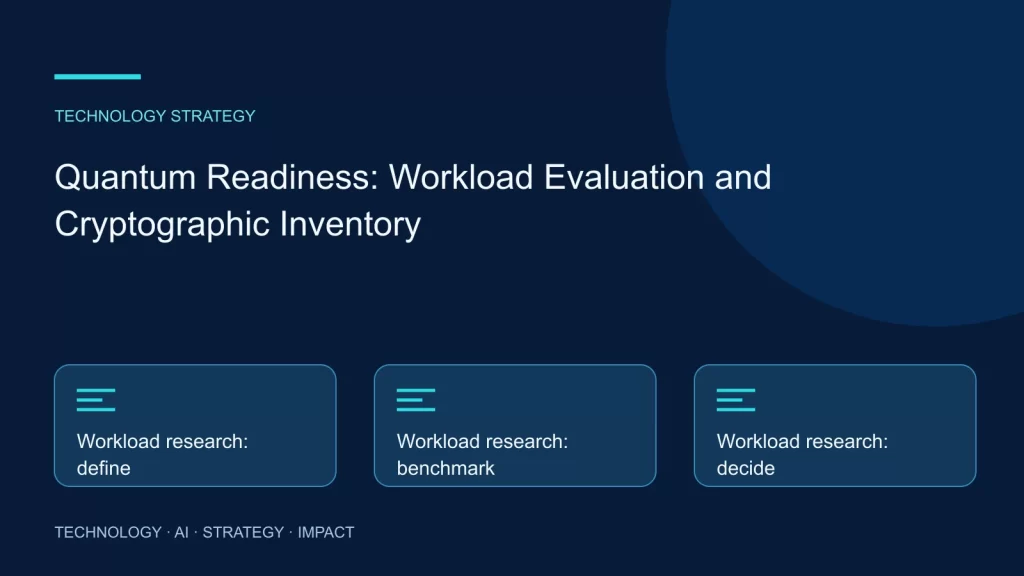
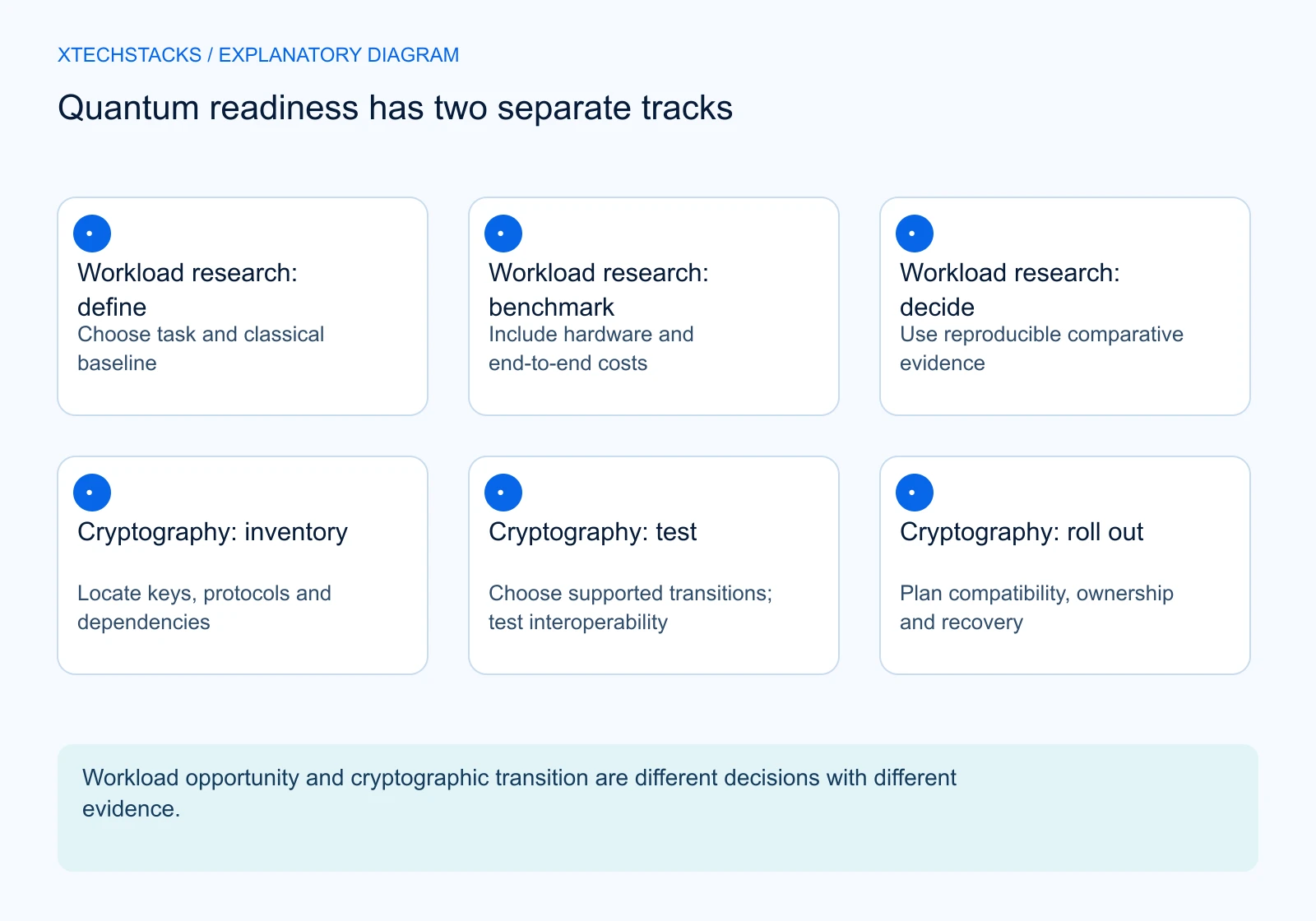
Enterprise quantum readiness should distinguish two activities: evaluating a proposed computational workload and preparing cryptographic systems for relevant future threats. They require different evidence, owners and implementation paths. Treating them as one innovation program can obscure the work that is actionable today.
This article focuses on those decision boundaries. It complements the introductory quantum-computing article without claiming a completed customer project, a benchmark advantage or a predicted hardware-readiness date.
Start with separate questions
A computational evaluation asks whether a quantum approach could improve a defined task compared with an appropriate classical method. A cryptographic review asks where vulnerable dependencies exist, which data needs long-term protection and how supported replacements can be introduced.
Assign owners accordingly. A research team may explore algorithms, while security and platform teams manage cryptographic inventory and migration. Shared executive interest does not make their acceptance criteria interchangeable.
Define a workload benchmark
Specify the input, output, accuracy requirement and relevant scale. Choose a credible classical baseline and include preparation and analysis costs. A comparison against an intentionally weak baseline provides little architectural evidence.
Document why the proposed algorithm is relevant to the task. Avoid broad assertions that quantum computing accelerates every optimization problem. Evidence from a small experiment should identify its scale and assumptions rather than imply production suitability.
Assess execution constraints
Quantum execution depends on hardware quality, noise, circuit requirements and error-management capabilities. The number of physical qubits is not a complete capacity measure. Review the resources needed for the actual computation and the limitations of the available system.
Keep classical orchestration in the evaluation. Encoding data, repeated execution and interpreting results are part of the workload. Provider access and configuration should be recorded so reviewers can understand which result was obtained under which conditions.
A hypothetical evaluation record
Consider a team investigating a narrowly defined simulation problem. Its record includes the problem specification, classical reference result, quantum approach, execution configuration and observed limitations. Acceptance depends on the complete comparison, not on whether a circuit returned output.
The team may conclude that further research is useful while production adoption is not justified. That is a legitimate outcome. Preserve the evidence and revisit the decision only when a relevant assumption changes.
Inventory cryptographic dependencies
Identify protocols, certificates, libraries, hardware integrations and external services that rely on relevant cryptography. Include data lifetimes and the systems responsible for protection. An inventory limited to application source can miss dependencies in infrastructure or third-party services.
Record ownership and supported upgrade paths. Avoid transmitting private keys or credentials into assessment documents or general-purpose model tools. Inventory should describe dependencies and configuration, not collect sensitive secret values.
Plan supported transitions
Post-quantum cryptography is implemented on classical systems and is distinct from quantum cryptography. Follow authoritative standards and vendor support. A migration is not simply replacing a string in configuration; interoperability, performance, lifecycle and recovery need testing.
Use the existing change-control process. Test supported implementations in the intended environment and document exceptions. Do not introduce an unreviewed custom cryptographic scheme or describe a new algorithm as universally unbreakable.
Prioritization and operating trade-offs
Research investment should reflect a specific technical question and an explicit review point. Security transition work should reflect exposure, dependency constraints and data-protection requirements. Unsupported urgency and arbitrary timelines make both activities harder to govern.
Vendor and provider roadmaps are inputs to planning, not guaranteed outcomes. Maintain records of which capabilities are currently available and which are proposed. Avoid making customer or procurement commitments based solely on anticipated hardware progress.
Recommended approach
Create two concise workstreams. The first evaluates one defined workload with a complete baseline and documented uncertainty. The second builds a cryptographic dependency inventory and a supported transition plan. Keep their budgets, owners and acceptance evidence visible.
Review readiness periodically when standards, vendor support or workload evidence changes. The objective is a defensible decision, not adoption for its own sake. Classical solutions and existing security controls remain important while the investigation proceeds.
Exercise a transition in a test environment
Choose one supported integration and identify its clients, certificate or key lifecycle, dependency versions and recovery procedure. Test the intended transition with representative peers before changing the production configuration. Record interoperability failures and any performance or resource constraints observed in the actual environment.
Verify how the system behaves when one participant has not yet been upgraded. A coordinated migration may require a compatibility window or another vendor-supported approach. Keep the rollback conditions explicit and review them with the responsible security owner. Do not silently weaken protections to make an interoperability test pass. The test record should distinguish measured behavior from expectations based only on documentation.
Key takeaways
- Separate workload research from cryptographic migration.
- Compare complete computations with credible baselines.
- Inventory dependencies without collecting secrets.
- Use supported standards and tested transition procedures.