
Six content considerations
- Use relevant visuals. Choose a diagram, example or image that helps explain the subject rather than one added only to stop scrolling.
- Participate in useful discussions. Reply with relevant information and treat the platform as a professional conversation, not only a publishing channel.
- Be transparent about outreach. Make the purpose of a business message clear. Avoid presenting an unsolicited sales pitch as a personal conversation.
- Keep personal content relevant. Share context that supports the topic without assuming that a selfie or particular format guarantees engagement.
- Evaluate substance, not follower count. Review the quality and attribution of content before treating an account as authoritative.
- Maintain an owned channel. A website and consent-based newsletter can complement platform publishing. Measure results instead of relying on assumed algorithm behavior.
Measure the right outcomes
Track meaningful engagement, useful conversations and visits to relevant resources. Compare formats and topics over time, accounting for changes in audience and publishing frequency. Do not infer a universal platform rule from one post’s performance.
Define the audience and useful topic
For a technical company, useful content starts with a reader’s actual question. Choose a concrete architecture decision, failure mode or lesson and explain the relevant constraints. A broad trend statement may attract attention while providing little help to the intended audience.
A hypothetical post about model versioning can identify why code history alone is insufficient and show a small release manifest. That is a clearer editorial contribution than claiming a technology will transform every business. Keep the topic narrow enough to support its claims.
Use evidence rather than algorithm promises
Do not present an assumed distribution algorithm as a reliable growth formula. Platform behavior and audience response can change, and a single successful post does not establish a universal rule. Focus on the quality of the contribution and measured responses from the relevant audience.
Distinguish observations from explanations. If engagement changed after a format change, record what was observed without claiming causation automatically. Audience, timing, topic and distribution may all have changed together.
Preserve technical accuracy in a short format
A short post should still state important limitations. Link to an authoritative source or a deeper article where useful, and avoid removing caveats merely to create a stronger opening. An architecture diagram should label whether it is a proposal, a hypothetical example or an implemented system.
When discussing experience, use only verified project details that may be shared. Do not fabricate customer names, benchmarks or outcomes. A credible technical company can explain a useful pattern without presenting every example as a completed customer success.
Choose format around the material
A compact diagram can clarify relationships; a text post can explain a trade-off; a longer article can provide implementation context. Select the format that makes the idea easier to understand rather than copying a format solely because it appears popular.
Make diagrams readable and provide meaningful surrounding text. Avoid cramming a complete system into a small graphic with unreadable labels. Ensure the central argument remains understandable when the image is not available to the reader.
Maintain a human editorial process
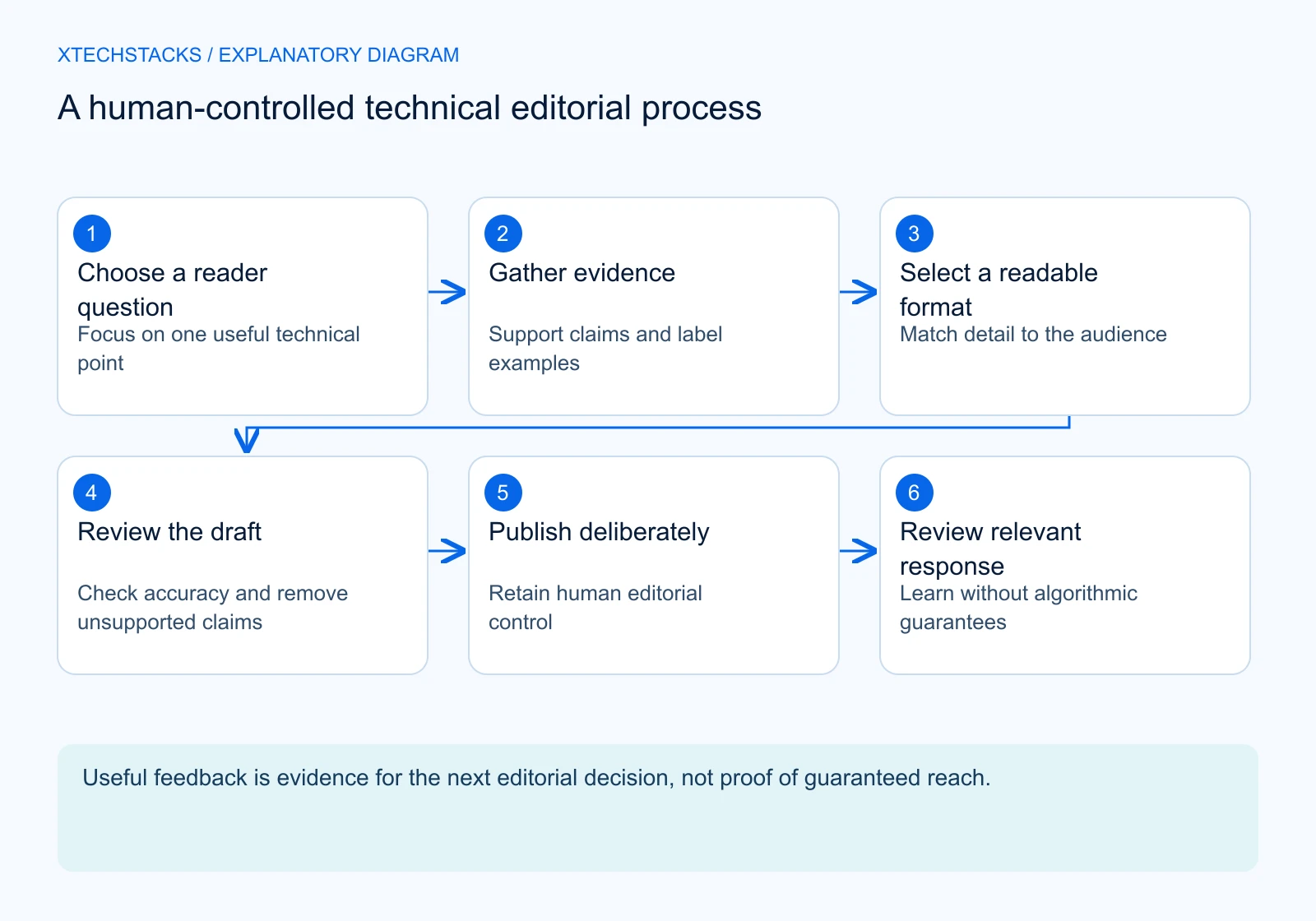
Draft from an explicit outline and review factual claims, tone and references before publication. Generated wording can support drafting, but the author remains responsible for accuracy and appropriate disclosure. Remove repetitive slogans, decorative emojis and unsupported certainty where they weaken the technical point.
Do not automate comments or outreach merely to increase visible activity. Keep responses relevant to the discussion and human-controlled. A thoughtful correction or explanation is more useful than repetitive promotional replies.
Review the right outcomes
Use available analytics to understand which topics reached the intended audience and prompted meaningful questions. Impressions alone do not demonstrate consulting demand or commercial value. Track useful discussion and clearly attributable enquiries where appropriate.
Compare posts with enough context to avoid misleading conclusions. Different topics and publication ages are not directly interchangeable. Record what can be learned and what remains uncertain instead of turning a small sample into a definitive strategy.
Recommended approach
Maintain a small editorial backlog of practical questions, each with a source or concrete engineering explanation. Publish at a sustainable pace that preserves review quality. Reuse deeper website articles as reference material without duplicating promotional language everywhere.
This is an editorial operating approach, not a guarantee of ranking, reach or revenue. Adapt it using relevant feedback and keep the company’s technical credibility ahead of publishing volume.
Key takeaways
- Choose a specific reader question.
- Support claims and label illustrative examples.
- Use readable formats and human review.
- Measure relevant response without promising algorithmic reach.
A concrete editorial review
Before publishing the versioning example, check that the manifest fields are illustrative, the technical explanation matches its references and the image remains readable on mobile. Remove any implied customer result that the author cannot substantiate. The review should improve the reader’s understanding, not merely make the opening more promotional.