When a production model behaves unexpectedly, the model file alone rarely explains the incident. Its behavior depends on training inputs, feature logic, software libraries, runtime configuration and the deployment path. Reliable MLOps requires those dependencies to be identified and connected.
Versioning is the mechanism that turns “the model changed” into an answerable engineering question: which component changed, what evidence supported the release and can the previous behavior be recovered? This is a system-level requirement, broader than selecting a dataset-versioning tool.
Version the release, not only the model
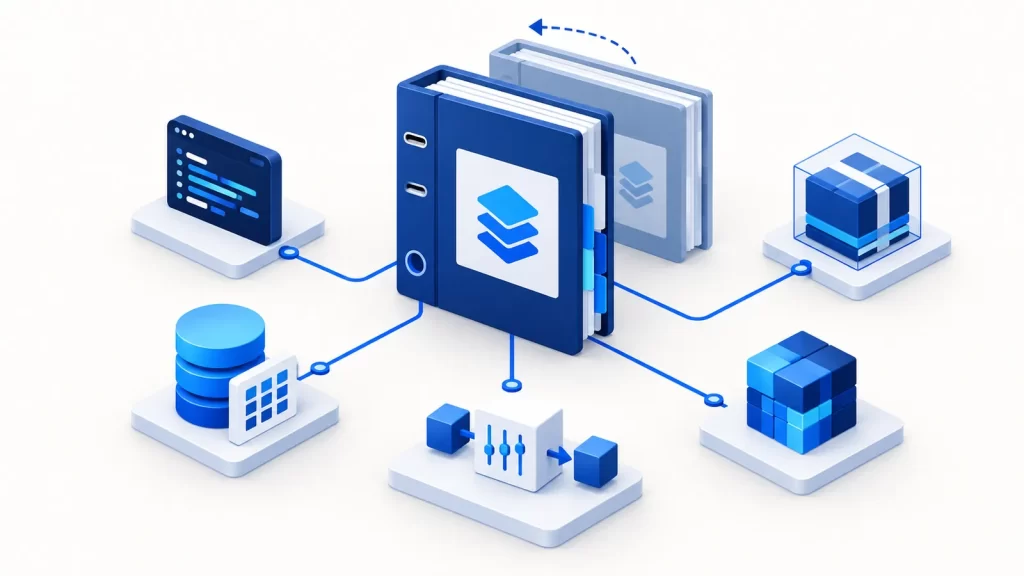
A release needs references to code, data, feature definitions, the model artifact, configuration, environment and pipeline definitions. These components do not have to live in the same repository. They do need stable identities and a release manifest that connects them.
Use content hashes, immutable artifact identities or authoritative snapshots where appropriate. A friendly label such as production is useful for discovery but is mutable. Resolve it to the exact artifact when recording a deployment. Avoid replacing a file in place and relying on its unchanged name as evidence of identity.
What each version contributes
| Component | Record needed | Question it answers |
|---|---|---|
| Code and pipeline | Reviewed commit and stage definitions | Which execution logic ran? |
| Training and evaluation data | Recoverable snapshot references | Which records supported the result? |
| Features | Transformation revision and schema | How were inputs represented? |
| Model and configuration | Artifact identity and parameters | Which candidate was deployed? |
| Environment | Dependency lock and runtime image | Which software executed the package? |
Include the evaluation dataset separately from the training dataset. Record seed values and relevant execution settings. Some operations remain nondeterministic across hardware or software, so distinguish exact artifact recovery from a promise of bit-for-bit retraining.
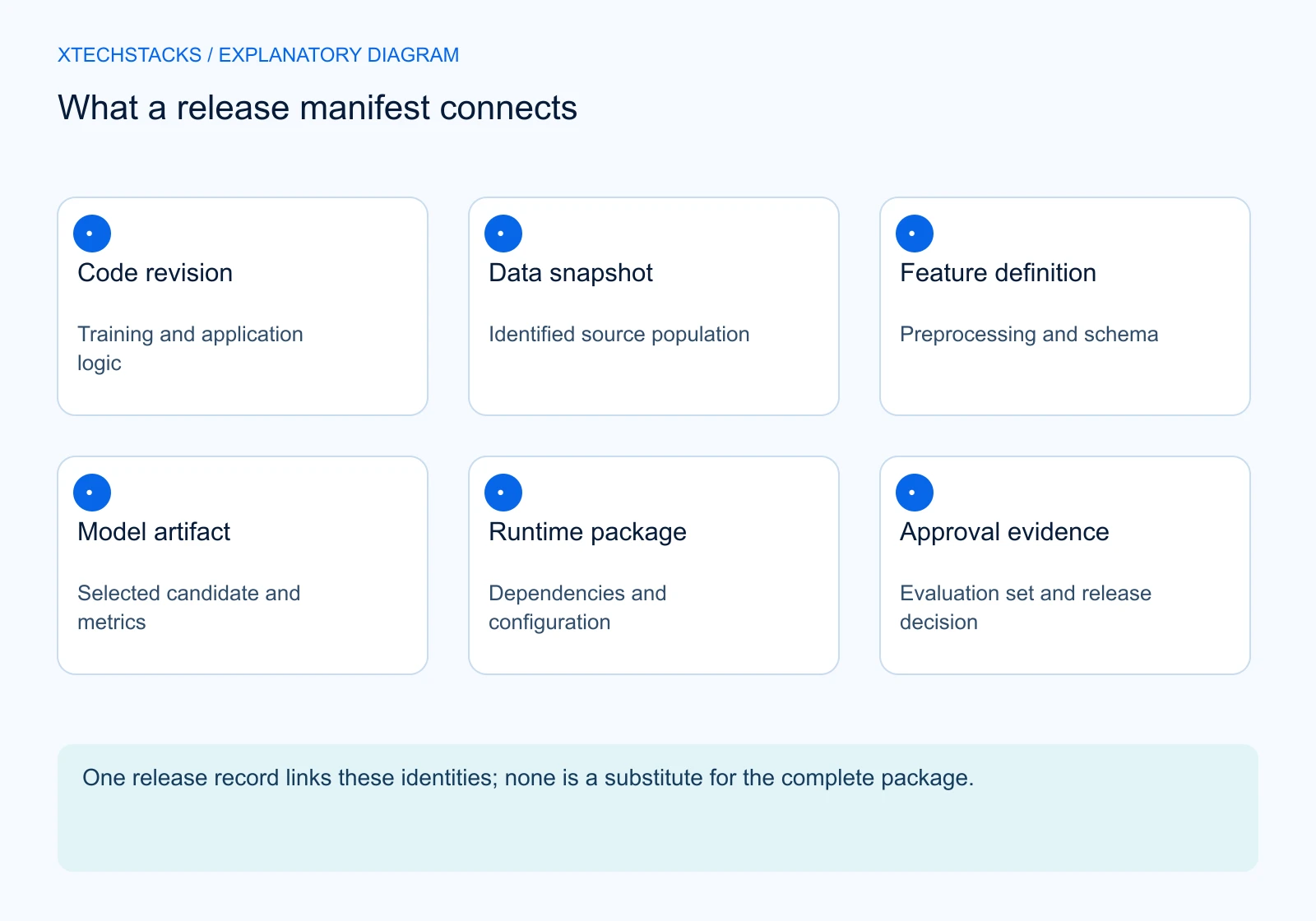
Lineage connects these identities
Independent version numbers are insufficient. The useful relationship is that training run A consumed dataset B using feature definition C and code revision D, produced artifact E and passed evaluation F before deployment G. Without those edges, investigation still depends on guessing which versions belong together.
Capture lineage at execution time. Trying to reconstruct it after an incident is less reliable, especially when mutable data sources or temporary jobs have disappeared. Keep the manifest close to the approved artifact and ensure the deployment process records the manifest it actually used.
A hypothetical incident: model v17
Suppose a ticket-routing service reports more incorrect assignments after deploying model v17. The infrastructure dashboard is healthy, and the aggregate evaluation score was acceptable. The release manifest shows that v17 used dataset d42, feature revision f9 and serving image s12. The previous accepted release used d41, f8 and s11.
The investigation first replays fixed evaluation examples through both serving packages. It finds that a missing-value transformation in f9 maps a newly absent field differently. The change affects one ticket source that was underrepresented in the evaluation set. This is an illustrative scenario, not a reported XTechStacks customer incident.
With linked versions, the team can isolate preprocessing from the model itself, restore a compatible prior package and create a targeted regression test. Without them, retraining might appear to help temporarily while the inconsistent transformation remains in production.
Design a usable release manifest
release: ticket-router-v17
code_revision: reviewed-commit-reference
training_data: approved-snapshot-d42
evaluation_data: fixed-evaluation-e8
feature_revision: f9
model_artifact: immutable-artifact-reference
runtime_image: image-digest-reference
pipeline_revision: pipeline-p6
approval: reviewed-evaluation-record
This example defines the relationships to capture, not a particular tool’s configuration syntax. Validate that each referenced object exists and can be recovered by an authorized operator. The approval record should identify the evidence and decision; it should not contain credentials or unnecessary personal data.
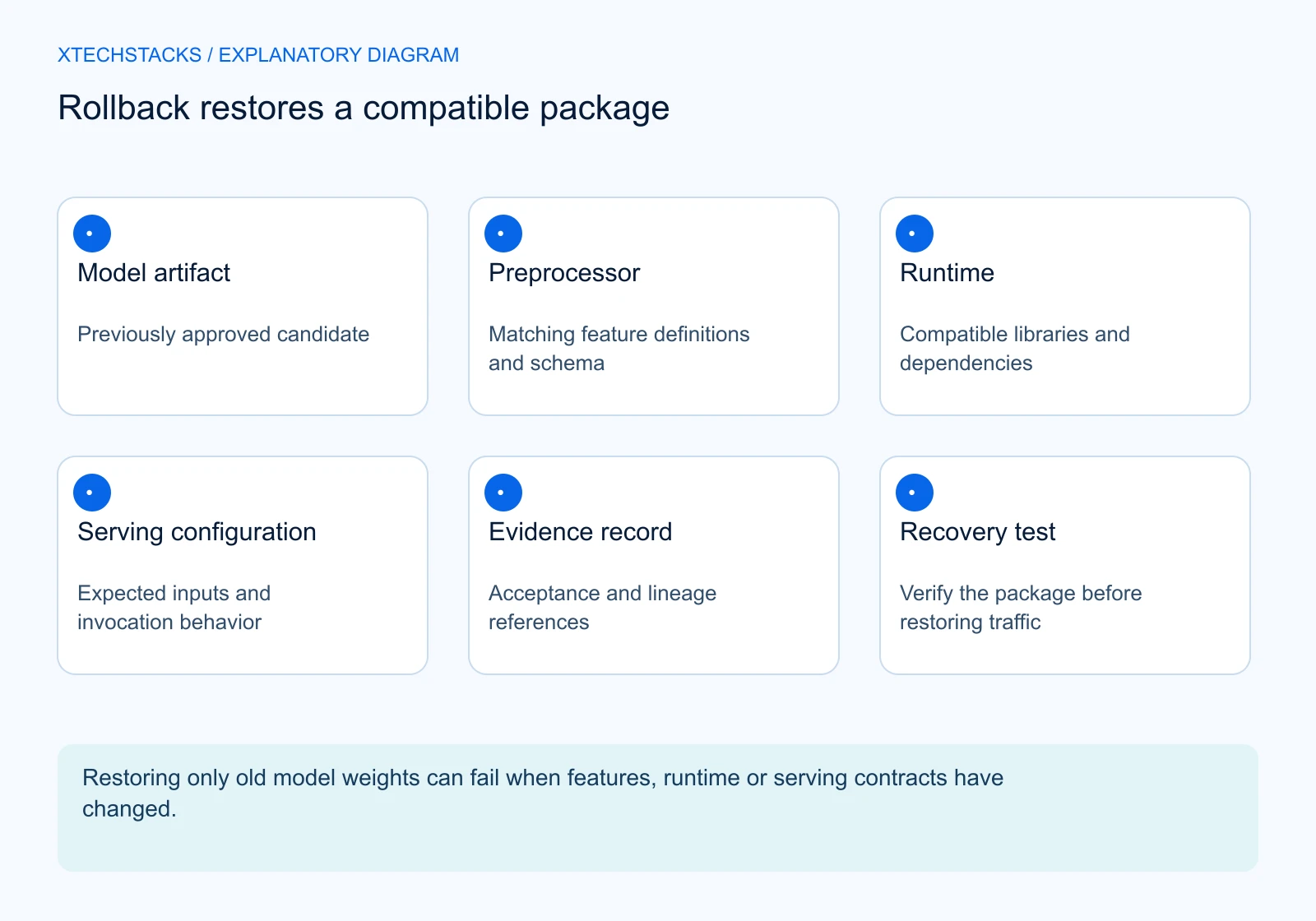
Rollback is a compatibility exercise
Replacing the model artifact may not restore the old behavior if features, schemas or runtime libraries changed. Roll back a known-compatible package, and test whether current inputs still satisfy its contract. Retain an operational fallback when upstream data cannot be restored safely.
Also separate recovery from retraining. Recovery restores an approved operating state. Retraining creates a new candidate that still requires evaluation. Both use version history, but they serve different incident-response decisions and should not share an automatic promotion rule.
Trade-offs, retention and auditability
Keeping every large snapshot forever is costly and may conflict with deletion obligations. Define retention around approved releases, investigation windows and permitted use. A reference to a deleted object remains useful as an audit record, but it no longer enables complete reproduction. Make that limitation explicit.
Tools divide these responsibilities differently. Git tracks code; data-versioning systems track artifacts or snapshots; experiment systems record runs; registries manage model identities; deployment systems record serving packages. Assess the gaps between them rather than assuming one product provides end-to-end lineage.
Recommended approach
Begin with a mandatory release manifest for one pipeline. Require explicit training and evaluation references, immutable deployment identities and a restore test. Make missing lineage a failed release check, not a documentation task postponed until after launch.
Then extend coverage to shared features, upstream contracts and delayed feedback. Versioning is valuable when an engineer can use it to reproduce a decision, explain a regression or restore service. The version label itself is only the starting point.
Key takeaways
- Connect code, data, features, configuration, artifacts and environment.
- Capture lineage during execution, not after a failure.
- Rollback a compatible package rather than an isolated model file.
- Align retention with the recovery promise and data obligations.