Artificial intelligence, machine learning and deep learning are related terms, not interchangeable labels. Machine learning is a subset of AI; deep learning is a subset of machine learning.
Artificial intelligence
AI is the broad field of building systems that perform tasks associated with intelligence, such as prediction, planning or language processing. It includes approaches based on rules as well as methods that learn from data. AI does not require a literal replica of a human brain.
Machine learning
Machine learning uses data to fit a model that can make predictions or other inferences. Examples include classification, forecasting and recommendation. The behavior depends on the training data, model and evaluation process.
Deep learning
Deep learning uses multilayer artificial neural networks. These networks learn numerical representations from data. They are inspired by some ideas about biological learning but are not equivalent to human neural systems.
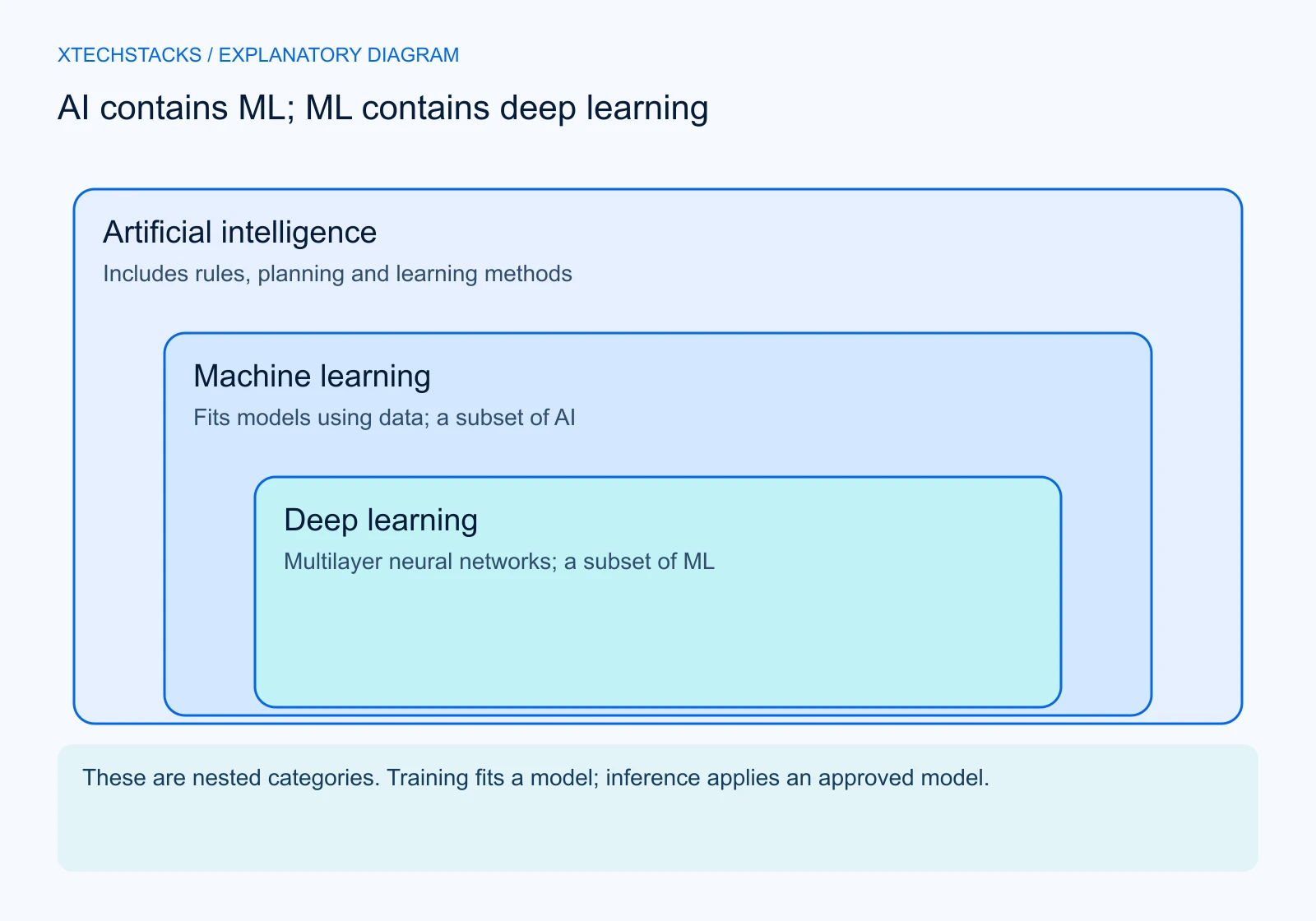
How the terms fit together
- AI is the wider field.
- Machine learning covers data-driven learning methods within AI.
- Deep learning covers neural-network methods within machine learning.
Compare AI systems by their intended task, operating constraints and evaluated performance rather than a single universal ranking. Architecture decisions need a clear problem definition and evidence appropriate to that problem.
Use the distinctions to make architecture decisions
AI is a broad field concerned with systems performing tasks associated with intelligence. Machine learning is a subset that learns patterns from data. Deep learning is a subset of machine learning using neural networks with multiple learned layers. These relationships do not imply that every task benefits from the most complex approach.
A rule-based system can be appropriate when the decision logic is explicit and stable. A learned model can help when examples better represent the task than manually written rules. Deep learning may be useful for certain complex representations, but brings data, training and serving requirements that need justification.
A practical classification example
Consider a hypothetical document-routing task. Rules can route documents with clear identifiers or known formats. A conventional classifier can learn from labeled examples using explicit features. A neural model can learn richer representations when the workload and available evidence support it.
Compare these approaches against the same representative evaluation procedure. Inspect unsupported inputs and relevant document groups. Do not assume that a neural model is better merely because its internal representation is more complex.
Training and inference are different stages
Training adjusts learned parameters using data and an optimization procedure. Inference uses an accepted artifact to produce outputs. Serving a model does not mean that it automatically learns from every request or updates itself with user corrections.
Record the artifact and transformations used at inference. If feedback becomes new training data, it needs a controlled collection and validation process. Keep candidate creation separate from the approval decision to replace the operating model.
Data and evaluation requirements
Learned systems depend on the relevance and quality of their examples. Labels, sampling, source permissions and evaluation splits all influence conclusions. A model can perform well on a convenient test set while behaving poorly on the intended operating population.
Define the task and acceptable failures before choosing a framework. Use representative segments and test boundaries that reflect time or entity leakage risks where relevant. Preserve a baseline so complexity is evaluated against a meaningful alternative.
Operational consequences
A rule system requires rule maintenance and tests for changing business logic. A learned model adds training evidence, artifact identity and monitoring of input and outcome behavior. A deep-learning system may also require specialized runtime or hardware management.
These obligations should affect platform selection. Choose batch or online serving according to the consumer, not the model family. A sophisticated model that cannot meet the required latency or recovery process is not automatically the appropriate architecture.
Explainability and human review
Different techniques support different forms of inspection, but no broad label guarantees explainability. A rule set can become difficult to maintain, and a simple model can still rely on unsuitable features. Document the evidence and limits of the explanation provided.
Where predictions influence consequential decisions, establish appropriate review and domain-specific requirements. Technical evaluation alone does not determine whether a system is suitable for every intended use. Keep unsupported capability claims out of architecture descriptions.
Trade-offs and recommended approach
Start with the simplest credible baseline and compare alternatives using task quality, operating cost and maintenance. More parameters or training effort do not by themselves establish better outcomes. Keep decisions tied to evidence rather than terminology.
Use AI, ML and deep learning as descriptive categories, not a maturity ladder. The reliable solution is the one whose behavior, data dependencies and operating limits the team can evaluate and own.
Key takeaways
- AI contains ML, and ML contains deep learning.
- Compare methods against a shared task and baseline.
- Separate training from approved inference.
- Account for data, runtime and maintenance obligations.