
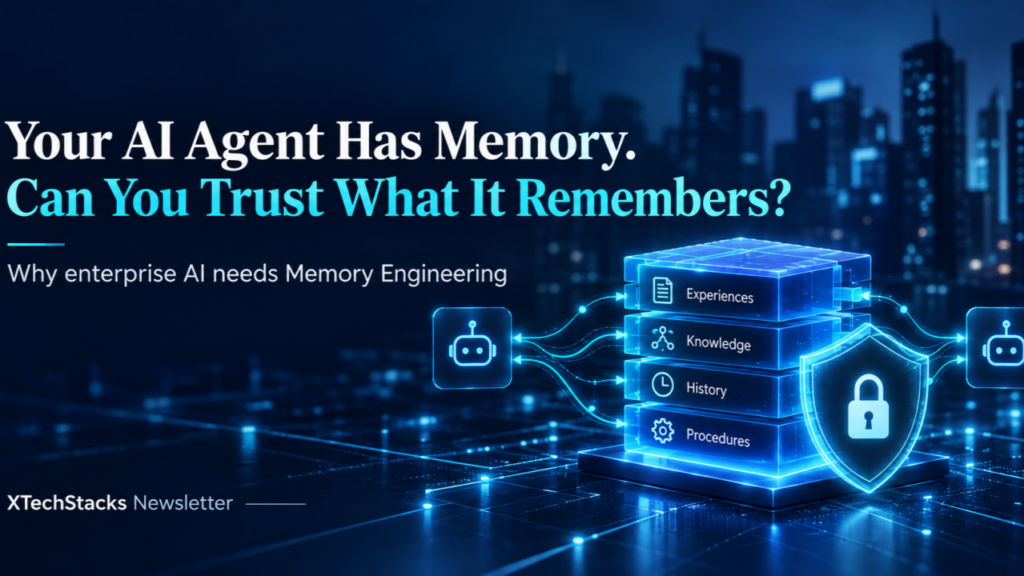
Why enterprise AI needs Memory Engineering—not just bigger context windows.
Imagine an enterprise AI agent learns this today:
“For this customer, Finance approval isn't required below $100,000.”
Six months later, the policy changes.
But the agent still remembers it.
Or perhaps that “memory” never came from an approved policy at all. It came from an employee conversation, an outdated document, a summarized interaction—or content deliberately designed to influence the agent.
The model isn't necessarily hallucinating.
It may be correctly recalling something it should no longer trust.
That distinction is going to matter enormously as enterprises move from stateless copilots to agents that persist experience across days, users and workflows.
For the last few years, we have worked hard to make AI remember.
The next challenge may be much harder:
What should an AI agent be allowed to remember—and when should an enterprise force it to forget?
Memory is becoming infrastructure
The first generation of enterprise GenAI was relatively simple:
Prompt → Model → Response
Then RAG became mainstream:
Prompt → Retrieve enterprise knowledge → Model → Response
Agentic systems introduce another loop:
Experience → Remember → Reuse → Act → Learn → Remember again
That last loop changes the architecture.
An agent no longer operates only on information supplied for the current request. It can carry lessons, preferences, procedures and previous outcomes into future decisions.
This isn't hypothetical.
Microsoft Foundry now supports session, user and procedural memory. Microsoft reported early Tau-bench experiments where procedural memory improved task success by 7–14 percentage points at near-baseline cost. It has also introduced TTL controls so developers can determine how long memories survive. Microsoft Dev Blogs
Earlier this month, Microsoft also introduced a preview integration giving Agent Framework agents durable cross-session memory backed by Azure Cosmos DB. Microsoft Dev Blogs
Oracle has similarly introduced a persistent enterprise-agent memory layer covering short- and long-term memory, retrieval, learned rules and cross-session context. And just this week—September 23—it expanded that architecture with graph-aware retrieval, memory updates and supersession, schema evolution and additional enterprise controls. Oracle Documentation
The direction is becoming clear:
Memory is moving from chatbot convenience to enterprise AI infrastructure.
And once that happens, memory requires engineering.
Context, RAG and Memory are different problems
These concepts are often mixed together.
Context asks: What does the model need to know right now?
RAG asks: What external evidence should we retrieve for this task?
Memory asks: What should this system retain from previous experience and reuse later?
A larger context window does not automatically provide durable memory, and RAG is not itself a memory system. Production memory introduces additional concerns including identity scope, provenance, permissions, lifecycle and deletion. Oracle Blogs
This distinction becomes important in an enterprise.
Suppose a procurement agent retrieves the official purchasing policy through RAG.
During the interaction someone tells it:
“Our team normally bypasses that approval.”
If that statement disappears after the session, the exposure is limited.
But if the agent converts it into durable memory, that information could influence future transactions.
Persistence changes the risk model.
The hard problem isn't storing memory
Vector databases, relational stores, graphs and object stores can all participate in memory architectures.
Storage isn't the interesting problem.
The difficult question is:
What deserves to become memory?
An enterprise agent can observe:
User conversations
Documents
Emails
Tool responses
API results
System events
Agent conclusions
Workflow outcomes
Previous failures
Human corrections
These don't carry equal authority.
Yet a naïve memory architecture can turn an observation into durable knowledge simply because an extraction model considered it useful.
That suggests an architectural principle:
A persistent memory write should be treated as a governed decision—not as a side effect of a conversation.
Instead of:
Interaction
     ↓
   Memory
consider:
Interaction / Event
        ↓
 Memory Candidate
        ↓
Source + Provenance
        ↓
Trust Evaluation
        ↓
Classification
        ↓
Authorization / Scope
        ↓
TTL + Retention
        ↓
 Persistent Memory
That is where Memory Engineering begins.
Four memories, four different risks
A useful enterprise model separates memory into at least four categories.
Working memory keeps temporary task state.
“We are currently investigating incident INC-4821.”
Episodic memory captures what happened.
“A similar production incident happened three months ago.”
Semantic memory represents learned facts.
“Application X depends on service Y.”
Procedural memory captures how work is performed.
“When this failure occurs, validate the database connection pool before restarting the service.”
Procedural memory is particularly interesting.
Microsoft describes a recurring enterprise-agent failure where an agent knows the necessary facts but still skips validation, misuses a tool or repeats a previously unsuccessful procedure. Procedural memory is intended to let agents reuse successful approaches across runs. Microsoft Dev Blogs
Now extend that idea beyond one agent.
Incident resolutions.
Architecture decisions.
Customer exceptions.
Manufacturing interventions.
Successful troubleshooting sequences.
Previous project failures.
Today, much of that knowledge disappears into tickets, meetings, chats and individual experience.
Tomorrow, appropriately governed agents could preserve it.
Enterprise memory could allow an organization—not merely an individual agent—to get better because of what happened yesterday.
That is the opportunity.
But it is also the risk.
What happens when memory is wrong?
There are several recurring failure modes.
Stale memory: something was once correct but reality changed.
Incorrect memory: an interaction was summarized or interpreted incorrectly.
Conflicting memory: two experiences produce contradictory conclusions.
Cross-boundary memory: information learned for one user, customer or business unit becomes available somewhere it shouldn't.
Memory poisoning: malicious information becomes durable memory and influences future behavior.
The security problem is particularly important.
Research published September 8 introduced MemSentry, examining persistent-memory poisoning in agentic systems. The proposed architecture evaluates memory writes using source trust, semantic risk, dependency impact and access risk before deciding whether a memory should be accepted, reviewed or quarantined. arXiv
Other 2026 research has demonstrated that manipulated environmental content can contaminate agent memory and influence later tasks across sessions—and even across sites. arXiv
This gives us another architectural principle:
Persistent memory should be treated as a trust boundary.
We secure API calls.
We secure identities.
We secure databases.
We increasingly need to secure what an agent is allowed to learn.
There is also an economic problem
The simplest form of “memory” is to continually send more historical context to the model.
That doesn't scale particularly elegantly.
More history means more tokens, more irrelevant context, potentially more latency and more opportunity for conflicting information.
Oracle recently reported 93.8% accuracy on LongMemEval while using roughly 10.7× fewer input tokens than flat conversation history in its memory architecture evaluation. Oracle Blogs
The specific benchmark matters less than the architectural implication:
Good memory engineering can potentially improve both intelligence and economics.
The objective therefore isn't:
Remember everything.
It is:
Retain the smallest amount of trustworthy experience that materially improves future decisions.
That connects directly with another issue we've discussed at XTechStacks: Agent Economics.
A memory that costs money to store, retrieve, validate and inject into context but does not improve successful business outcomes isn't valuable memory.
It's technical debt.
The TRUST framework for enterprise memory
I use a simple framework for thinking about this problem:
T — Triage
Decide what deserves to become durable memory.
Ask:
- Is this useful beyond the current task?
- What is its source?
- Is the source authoritative?
- What happens if this memory is wrong?
Not every conversation deserves persistence.
R — Restrict
Every memory should have scope.
User
Agent
Team
Customer
Purpose
Sensitivity
Jurisdiction
An agent's ability to retrieve memory should follow enterprise identity and authorization boundaries.
A shared vector similarity score is not an authorization model.
U — Update
Memory cannot be append-only institutional folklore.
When reality changes:
Detect
  ↓
Revalidate
  ↓
Supersede
  ↓
Version
  ↓
Propagate
A newer memory should not simply coexist indefinitely with an obsolete one.
S — Surface
Retrieval should consider more than semantic similarity.
A useful mental model is:
Memory Retrieval
      =
Relevance
+ Authority
+ Freshness
+ Confidence
+ Permission
The closest embedding isn't necessarily the memory an agent should trust.
T — Terminate
Memory needs lifecycle management.
Create → Use → Review → Expire → DeleteSome memories may live for minutes.
Others months.
Some may require explicit review.
Others should never become persistent in the first place.
And when deletion is required, deleting a retrieval pointer while leaving derived summaries, embeddings and caches behind may not be enough.
One boundary matters above all
I would make one distinction explicit in every enterprise architecture:
Systems of record establish facts. Memory preserves experience.
They are not interchangeable.
If an ERP system says the supplier payment term is 30 days and an agent remembers that someone previously negotiated 60 days, the agent should not silently decide which reality is true.
Memory should retain provenance back to authoritative evidence wherever possible.
That produces a healthier architecture:
SYSTEMS OF RECORD
      Authoritative facts
              │
              │
              ▼
      ENTERPRISE KNOWLEDGE
              │
              ▼
        MEMORY ENGINE
              │
   ┌──────────┼──────────┐
   ▼          ▼          ▼
Episodic   Semantic   Procedural
 Memory     Memory      Memory
   └──────────┬──────────┘
              ▼
       MEMORY GOVERNANCE
              │
   Provenance | Trust
   Scope      | TTL
   Version    | Policy
              │
              ▼
        CONTEXT ENGINE
              │
              ▼
             AGENT
              │
              ▼
       ACTION + OUTCOME
              │
              └──────► Memory Candidate
The loop matters.
But so does the boundary.
Why this becomes expensive at enterprise scale
A single bad memory in a chatbot is annoying.
A bad memory reused by thousands of autonomous workflows can become expensive.
The pain therefore scales along several dimensions:
Frequency: potentially every agent interaction can generate or consume memory.
Operational cost: incorrect memories can cause repeated remediation, rework and failed workflows.
AI cost: uncontrolled history and retrieval increase token consumption and latency.
Security risk: poisoned memory can persist beyond the interaction that introduced it.
Compliance risk: personal, customer or sensitive information may survive longer or travel farther than intended.
Knowledge risk: organizations may gradually build an AI-generated layer of institutional knowledge whose provenance nobody can explain.
Business impact: as agents gain authority to execute rather than merely recommend, memory quality can directly influence business actions.
That changes willingness to pay.
Companies probably won't buy “memory engineering” because the phrase sounds interesting.
They will pay when memory affects:
agent reliability, security, compliance, operating cost or business outcomes.
What companies are likely to get wrong
I see five architectural traps emerging.
1. Treating memory as another vector database project.
The difficult problem isn't storage. It is lifecycle and trust.
2. Remembering too much.
More memory does not necessarily create a better agent.
3. Mixing enterprise truth with learned experience.
Authoritative records and inferred memory require different trust levels.
4. Securing agent actions but ignoring memory writes.
If an attacker can influence what an agent remembers, they may influence future actions without attacking those actions directly.
5. Building memory independently for every agent.
As organizations deploy dozens or hundreds of agents, isolated memory implementations create duplicated infrastructure, inconsistent policies and fragmented organizational knowledge.
That last issue is why I believe memory will eventually become a shared enterprise capability.
What should technology leaders do now?
You don't need an enterprise-wide memory platform tomorrow.
But if you're moving agents into production, I would start with six questions:
1. What can our agents remember today?
Inventory persistent state—not only vector stores.
2. Who can write memory?
Users? Agents? Tools? Applications? External content?
3. Can every important memory explain where it came from?
If not, provenance becomes an early priority.
4. How is memory scoped?
User, tenant, agent, customer, business unit and purpose boundaries should be explicit.
5. How does memory become stale?
Define TTL, versioning, supersession and revalidation.
6. Can we actually delete it?
Follow the memory into summaries, embeddings, caches, replicas and derived context.
Start with one production agent.
You will probably discover that memory architecture is less about remembering and much more about controlled forgetting, correction and trust.
Where I think this is heading
Memory Engineering is unlikely to remain a feature buried inside individual agent applications.
I expect enterprises to gradually develop a shared layer providing:
Memory ingestion
Provenance
Classification
Identity & isolation
Trust scoring
Lifecycle
Conflict resolution
Evaluation
Observability
Deletion
That layer could eventually sit alongside other enterprise-agent infrastructure:
Identity → Policy → Memory → Economics → Observability → Reliability
And this leads to the larger idea we've been exploring:
The future enterprise shouldn't merely deploy agents. It should become capable of learning from its own operations—without surrendering control over what it learns.
That is one of the foundations of what I think of as the Adaptive Autonomous Enterprise:
An organization that can sense, decide, act, remember, learn, recover and optimize, while humans retain control over intent, policy and risk.
Memory is what connects today's action to tomorrow's intelligence.
The question isn't whether our agents will remember.
The question is whether we will engineer what they remember well enough to trust what happens next.
XTechStacks perspective
There is a repeatable enterprise problem hiding here.
A practical Agent Memory Readiness Assessment could examine:
Memory inventory → Sources → Provenance → Classification → Isolation → Authorization → Freshness → Conflict handling → Evaluation → Retention → Deletion
That could evolve into reference architectures, governance controls and memory-evaluation tooling.
I would not rush to build another memory database. Major platform vendors are already investing heavily there.
The more interesting XTechStacks opportunity is the layer above storage:
How does an enterprise govern memory consistently across models, agents, frameworks and data platforms?
That problem is portable, recurring and considerably harder for a platform vendor to solve completely because it intersects with each company's policies, business processes, risk appetite and systems of record.
A question for technology leaders
If one of your AI agents remembers something about your organization for the next six months:
Can you explain where that memory came from, whether it is still correct, who is allowed to use it—and how you would make the organization forget it?
If you're working through this problem in production, I would d be interested in comparing approaches. That's exactly the kind of architecture problem we're exploring at XTechStacks.
Xtechstacks Team
Originally published in XTechStacks Weekly on LinkedIn on September 27, 2026. Read the original edition.