Chatbots and voicebots can assist with routine interactions when their scope, integrations and escalation paths are well defined. They do not automatically produce cost savings or higher revenue.
Customer service
A bot can help users find approved information, check an order or route an enquiry. Account-specific actions require authentication and appropriate permissions. Questions outside the supported scope should move to a person rather than receive an invented answer.
Sales and operational workflows
- Collect information needed to route an enquiry.
- Assist with scheduling or a defined order workflow.
- Explain product information from approved sources.
- Draft responses for a human agent to review.
Personalization and privacy
Personalization depends on what data is available and permitted for use. Define consent, access and retention rules before connecting customer records. A language model should not be assumed to remember every customer or to understand every request correctly.
Measure the outcome
Compare a pilot against the current workflow. Track completion rates, incorrect responses, escalation, customer feedback, latency and total operating cost. Include integration, monitoring, maintenance and human support in the cost calculation.
Start with a bounded use case
Select a task with clear inputs and an observable result. Test representative and failure cases before expanding the scope. Keep changes to prompts, models and knowledge sources under version control.
Architecture of a bounded service assistant
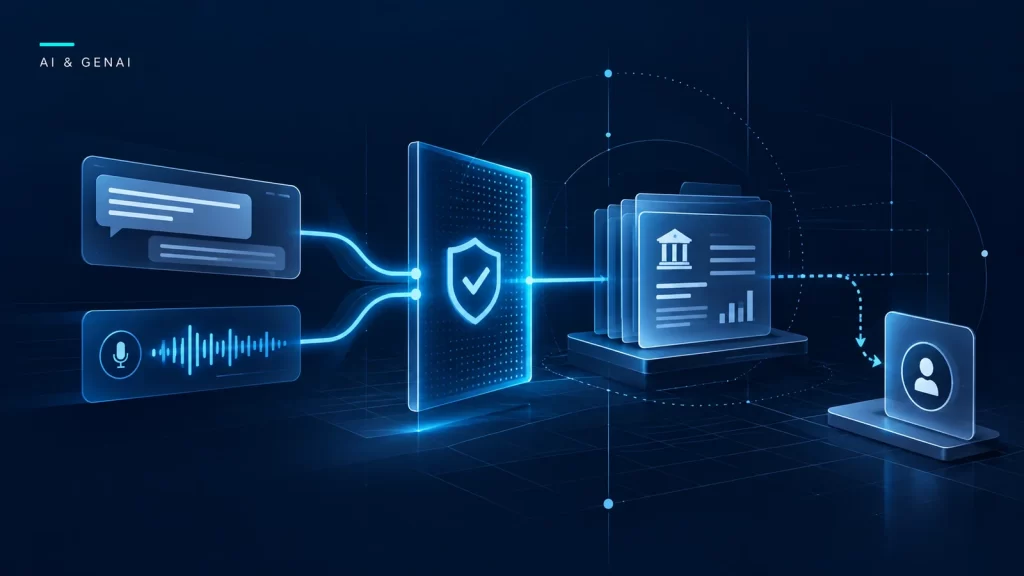
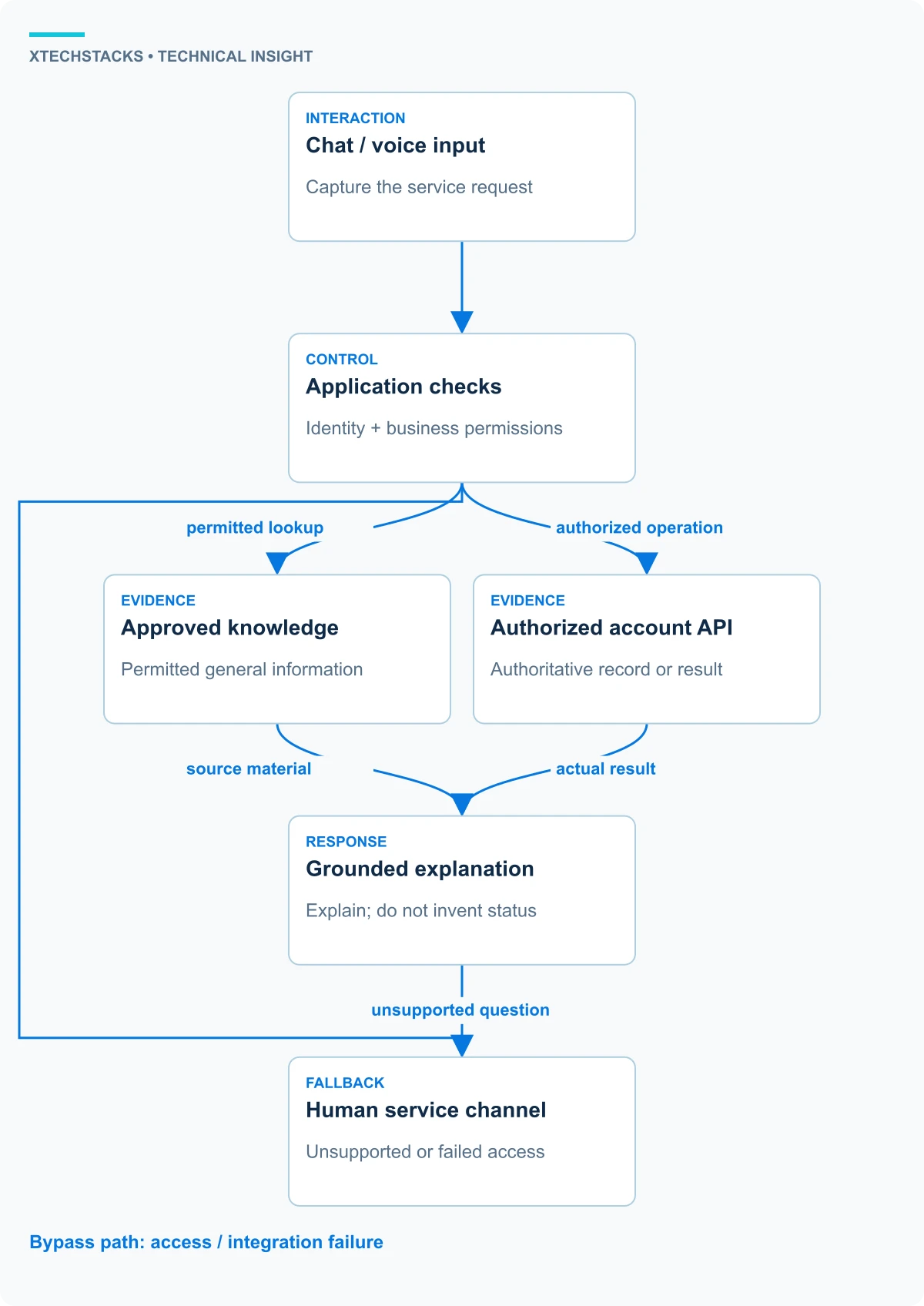
Separate conversation handling from account access and business actions. The interface captures a request; the application authenticates the user; approved knowledge supports an answer; and a controlled integration performs only permitted operations. A model’s interpretation of intent should not become unrestricted authority over customer systems.
For a hypothetical order-status assistant, retrieve the authorized order record through an ordinary application API. Use generated language to explain the result, not to invent its status. If identity or access checks fail, stop that path and offer an appropriate human channel. Keep promotional suggestions outside the essential service response.
Chat and voice have different failure modes
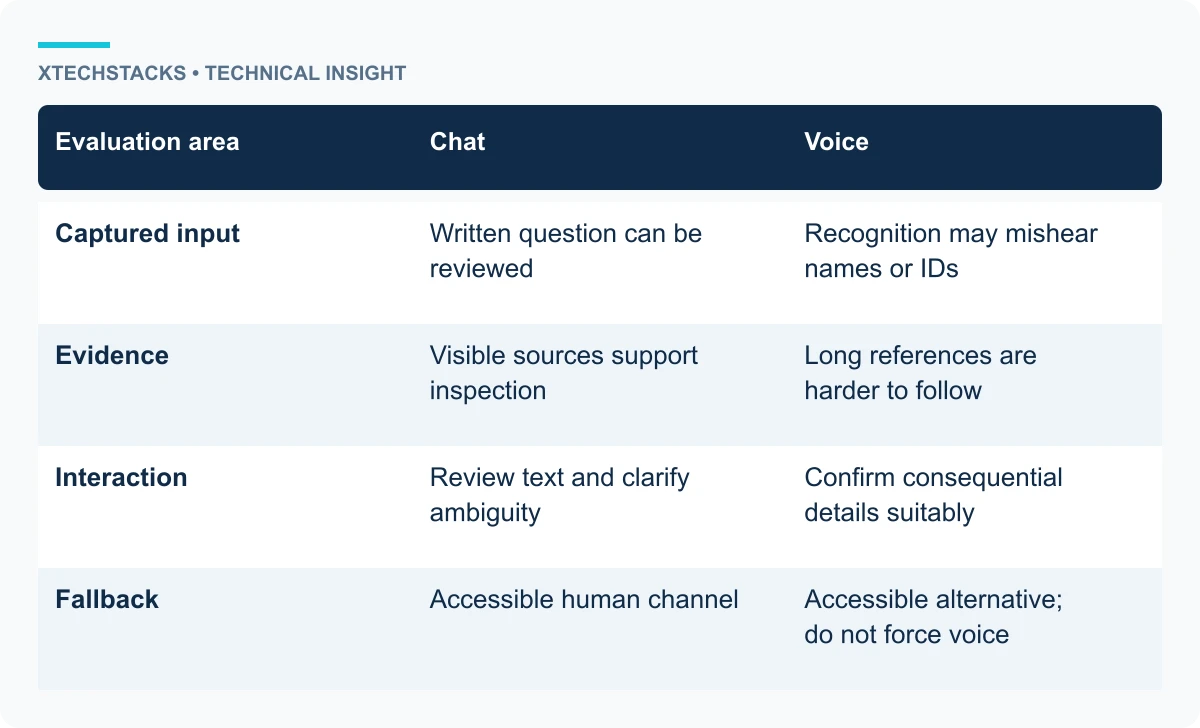
Voice workflows add speech recognition, turn timing and playback. Misheard identifiers or names can change the intended task before a language model receives it. Confirm sensitive or consequential details through a suitable interaction rather than assuming a fluent transcript is accurate.
Chat supports visible references and review, while voice may make long disclosures or complex instructions difficult to follow. Design each channel around its interaction constraints. Provide an accessible alternative, and do not force users through an automated conversation when the task requires a person.
Integration and data boundaries
Minimize the information sent to model providers. Separate public knowledge from account-specific records, and define retention for conversation logs. A support transcript can contain sensitive details even when the product is not intended for sensitive use.
Validate output before inserting it into a business workflow. A draft email, a CRM note and a transaction request have different review requirements. Record the authoritative system’s result separately from the assistant’s explanation so an investigation can establish what actually happened.
Evaluation and operating evidence
Build test cases for correct answers, ambiguous requests, unsupported questions, identity failures and unavailable integrations. Measure whether the task is resolved accurately and whether escalation works. Do not use conversation volume alone as evidence that customers benefited.
Compare a bounded pilot with the current process. Record the quality of resolution, user effort, human workload, latency and total operating cost. Keep sample selection and unhandled cases visible. A claim of increased revenue needs relevant measured evidence, not a general assumption that automation creates growth.
Action controls and recovery
Where an assistant changes a record, require an explicit action contract and appropriate confirmation. Validate identifiers and permitted fields in code. Use idempotency or destination-state checks so a retry does not perform the same action twice.
If a provider fails, preserve access to the underlying service channel. If knowledge is stale, disable the affected answer path instead of allowing guesses. Design the fallback before launch and verify that operational staff can identify and pause a problematic integration.
Implementation trade-offs
A rule-based workflow may be more predictable for a narrow, structured request. A language model can help with varied wording and drafting, but adds evaluation and data-handling obligations. Choose the smallest mechanism that serves the task and preserves the required control.
Begin with one service question and one source of truth. Introduce additional intents only when the first workflow has clear acceptance evidence and an accountable owner. Broad conversational coverage is less useful than a limited capability that fails honestly and reaches a human when necessary.
Key takeaways
- Keep identity and business permissions in application code.
- Evaluate chat and voice interactions separately.
- Measure task outcomes rather than assuming revenue gains.
- Retain a clear human escalation and recovery path.
Test the handoff
During a controlled pilot, simulate an unsupported enquiry and an unavailable account API. Confirm that the assistant explains the limitation, preserves the relevant context permitted by policy and directs the user to a real service channel. A fallback link is insufficient if the receiving team cannot understand or resolve the request.