An MLOps technology stack is a set of capabilities that connect development with reliable operation. The wrong starting point is a list of popular products. The better starting point is a workload, its delivery requirements and the evidence needed to investigate or reverse a release.
Tools can support those requirements, but their boundaries matter. An experiment tracker does not necessarily capture every source snapshot. A registry does not automatically validate serving compatibility. A container platform does not determine whether a model is useful. Architecture should make these gaps explicit.
Start with the operating requirements
Identify whether the model runs as a scheduled job, an online service or an embedded component. Specify its input contract, output consumer, update frequency and acceptable failure behavior. Record who owns data quality, evaluation, deployment and incident response.
A hypothetical nightly classification job may need recoverable files, batch orchestration and reconciled results. A real-time classifier also needs request isolation, latency management and serving observability. Choosing the same infrastructure for both without examining their requirements often adds complexity rather than consistency.
Development and execution environments
Support exploration with notebooks or local tools, but move release-critical logic into repeatable jobs. Pin dependencies, separate configuration from code and make environment creation reproducible. Record runtime information alongside artifacts so another engineer can load the approved package.
Containers are one option for packaging. They still need base-image maintenance, dependency checks and hardware compatibility testing. If accelerators are required, document driver and runtime assumptions. Treat reproducibility as a tested property rather than a consequence of using a particular file format.
Data and feature management
Provide authoritative input identities, schema validation and access control. File-based projects may use artifact versioning; warehouse projects may use supported snapshot references. Streaming projects require explicit windowing and replay assumptions. These mechanisms are not interchangeable simply because all can be called data versioning.
Feature definitions should be shared and tested across training and serving. A feature store becomes useful when managed reuse, point-in-time retrieval or consistent online access justify it. For a smaller project, a well-tested transformation library and explicit snapshots may offer a simpler operating model.
Experiments, registries and release records
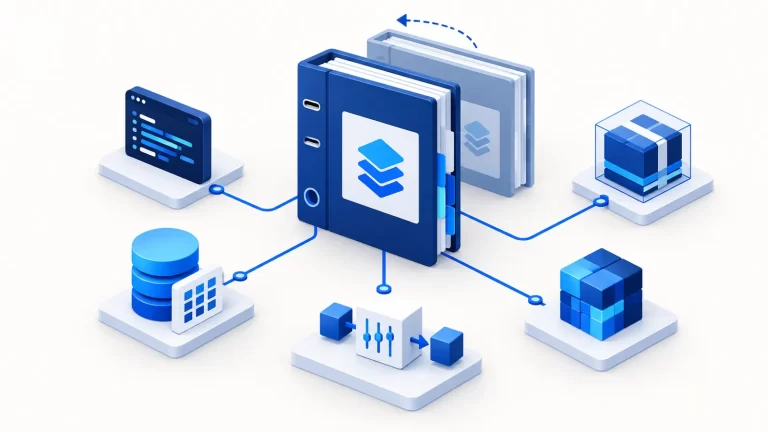
Experiment tracking records runs, parameters, metrics and artifacts. A registry manages model identities and can support promotion states. A release manifest connects the accepted model with its data, features, code, environment and approval evidence. Design how these records link before relying on the tools to do it automatically.
Compare candidates using a fixed evaluation procedure and representative cases. Keep segment-level regressions visible. An automated tracker can preserve a score, but it cannot decide whether the score reflects the intended operating population or whether a degraded segment is acceptable.
Orchestration and delivery automation
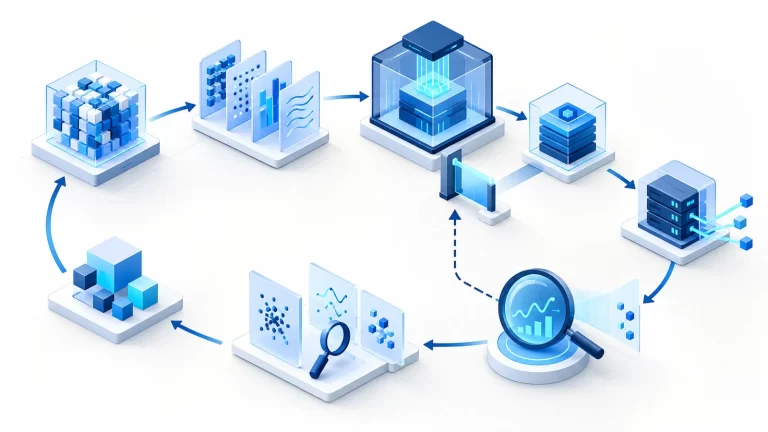
A workflow system should express dependencies, retries, timeouts and failure notifications. Define whether a stage can safely be repeated. Publishing the same output twice or training on a partially written snapshot is a correctness issue, not merely an infrastructure problem.
CI checks code and pipeline changes. Delivery promotes an approved package through environments. Automated training creates new candidates. Keep candidate generation separate from production approval, and give each automation identity the minimum privileges needed for its stage.
Serving and observability
Serving should validate input shape, apply compatible transformations and return a stable output contract. Select batch or online patterns according to consumer needs. Add admission limits and error handling for online requests, and completion and reconciliation controls for batch jobs.
Observe infrastructure health separately from model behavior. Latency and failures can be measured immediately; quality may depend on delayed labels. Drift indicators describe changes in distributions but do not prove that predictions are incorrect. Retain enough release context to relate a signal to a specific deployed package.
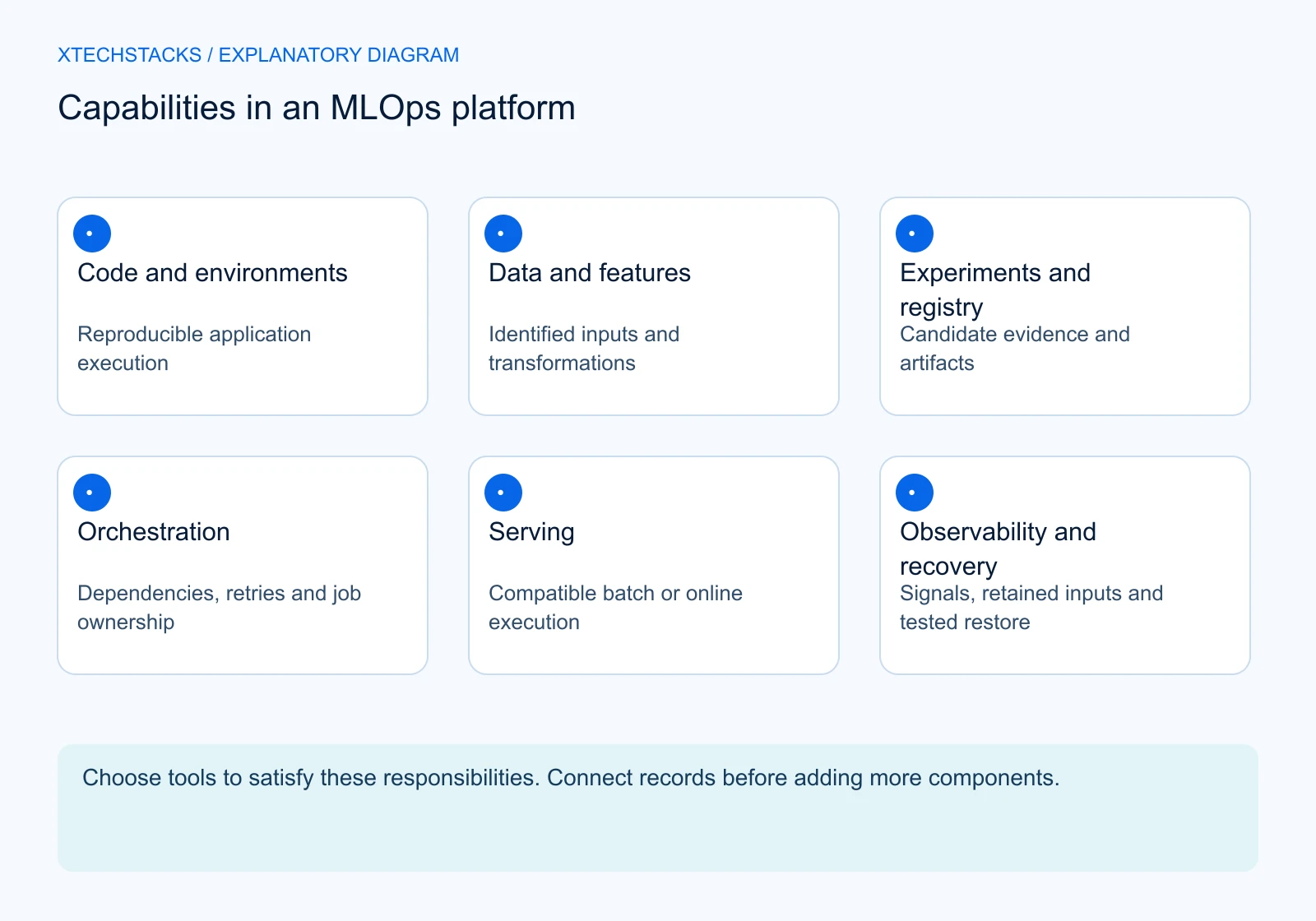
A practical capability map
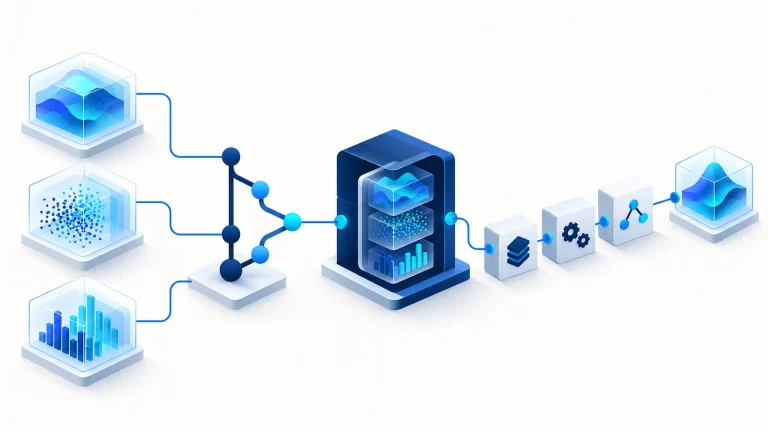
For the nightly classifier, a minimal map might connect a source snapshot, a transformation job, a recorded experiment, an approved artifact and a scheduled scorer. The scorer writes a versioned output and a completion record. A consumer accepts that output only after reconciliation confirms the expected input coverage.
The team can add a registry when multiple candidates and approval states become difficult to manage. It can add shared feature infrastructure when duplication creates observable inconsistency. These are evidence-driven extensions, not requirements imposed on every first release.
Trade-offs and recommended approach
Managed services reduce some infrastructure responsibilities but introduce service limits, integration constraints and vendor dependencies. Self-managed tools offer more control but require upgrades, backups, security and operational ownership. Compare the complete maintenance obligation, not only license price.
Document each capability, its owner, its authoritative record and its recovery procedure. Test one release from a clean environment and one rollback under controlled conditions. Where a chosen tool leaves a gap, record the gap explicitly instead of hiding it behind a broad platform label.
Key takeaways
- Choose capabilities around the workload before choosing products.
- Connect experiment, artifact and deployment identities.
- Use automation with explicit approval and retry boundaries.
- Validate restoration, not just the normal execution path.