Generative AI produces content such as draft text and summaries. In a contact center, it can support an agent’s workflow, but it should not be assumed to provide correct answers or improve customer outcomes automatically.
Useful tasks to evaluate
- Retrieve relevant material from an approved knowledge base.
- Draft a response for an agent to review.
- Summarize a conversation and suggest structured notes.
- Help route an enquiry using a defined classification workflow.
Customer-facing controls
Define authentication and authorization before exposing account information or permitting actions. Require escalation for unsupported questions. Test inaccurate retrieval, ambiguous requests and attempts to bypass application rules.
Measure rather than assume
Implement in stages
- Select one agent-support task.
- Prepare approved knowledge and representative evaluation cases.
- Review data access, retention and redaction requirements.
- Run a limited pilot with human review.
- Expand only after the observed results meet acceptance criteria.
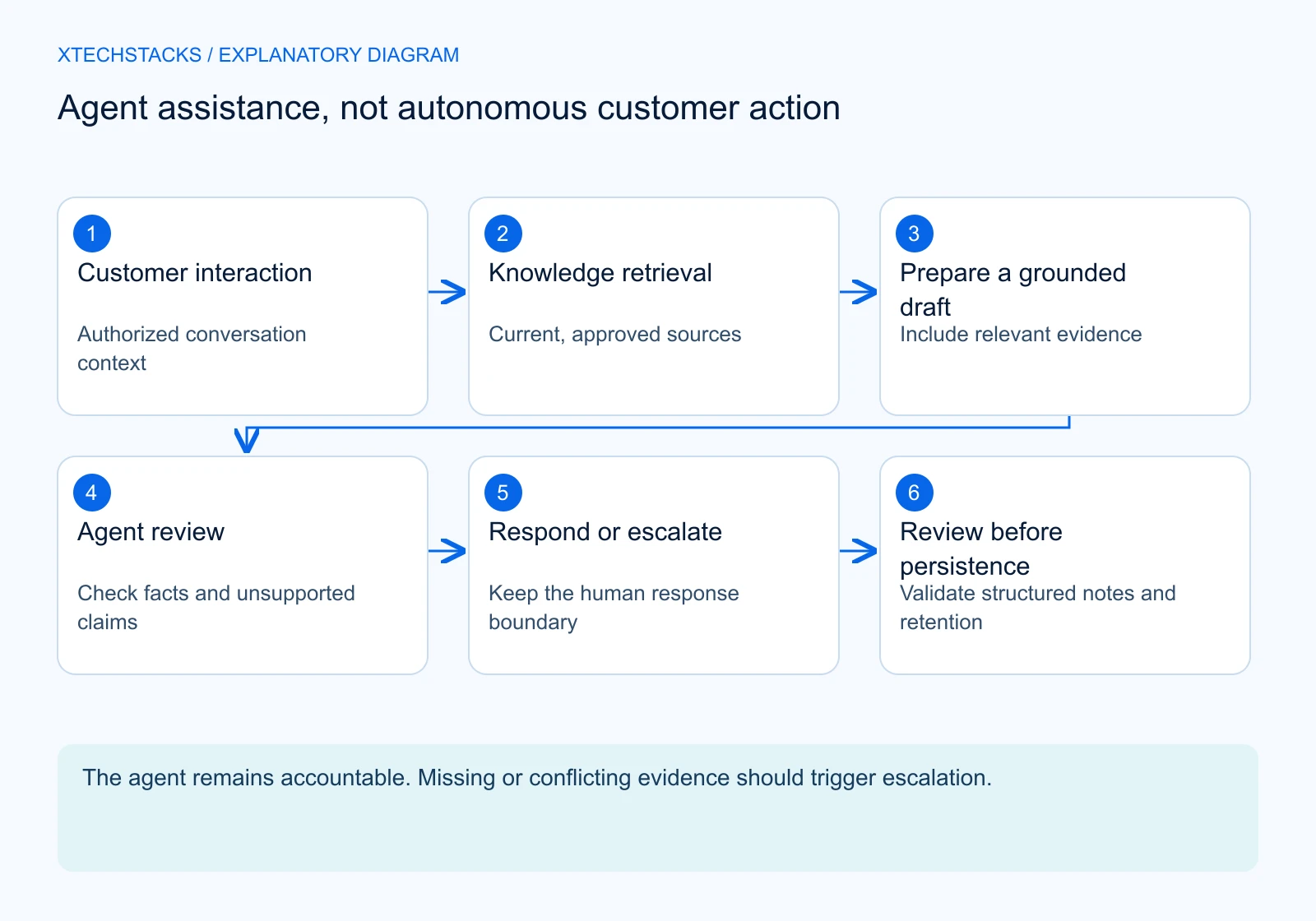
An agent-support architecture
Start with an assistant for a human agent rather than unrestricted customer-facing automation. The application retrieves approved knowledge, prepares a draft and shows the supporting material. The agent can accept, edit or reject the draft before it reaches the customer.
For a hypothetical billing enquiry, account access remains in the existing permission-checked system. A knowledge service supplies the relevant policy. The model explains that policy in context, but it does not determine account eligibility or authorize a financial action.
Knowledge preparation and freshness
Identify the authoritative policy owner and document lifecycle. Ingestion should preserve source identities, publication state and access restrictions. A retrieved passage from a superseded policy can produce a plausible but incorrect response.
Define how corrections, deletions and access changes reach the index. Test the retrieval of current policy separately from answer wording. Provide source references that an agent can inspect quickly; an answer without usable evidence increases review burden rather than necessarily reducing it.
Conversation summaries and structured notes
A summary should distinguish what the customer said, what was verified and what action was taken. Generated notes can accidentally convert a tentative statement into a confirmed fact. Require review before persisting consequential information in the customer record.
Validate structured fields and preserve the authoritative outcome from the underlying service system. Avoid retaining unnecessary sensitive conversation details. Define a correction process when a summary is inaccurate and ensure agents can report recurring failure patterns.
Channel and privacy considerations
Voice assistance adds transcript uncertainty and timing constraints. A misrecognized account identifier or a missed negation can alter the draft’s meaning. Test representative audio conditions and confirm important details through the established service process.
Review what conversation information is sent to each provider, how long it is retained and who can access traces. Redaction can help, but its failure modes need evaluation. Do not assume a general privacy disclaimer makes unrestricted transcript processing appropriate.
Pilot design and evaluation
Choose one task with a documented baseline, such as policy retrieval for a defined enquiry type. Evaluate retrieval relevance, answer correctness, review effort, escalation and latency. Include unsupported questions and contradictory source documents rather than testing only straightforward examples.
Compare the assistant-supported workflow with the current process using appropriate sampling. Track rejected drafts and the reasons for rejection. A shorter interaction is not necessarily better if it leaves the issue unresolved or creates later rework.
Action boundaries and escalation
Keep consequential account changes behind existing permission checks and required approvals. The model can prepare a suggestion, but the application must validate the intended operation and its inputs. Log the actual system result independently of the conversational explanation.
Give agents a dependable route to continue without the assistant during an outage or quality incident. Unsupported questions should escalate honestly. Avoid a design where a missing answer becomes an invitation for the model to invent a policy.
Trade-offs and a recommended sequence
Assistance can introduce new review work even when drafting is faster. Knowledge maintenance, evaluation and privacy controls are ongoing responsibilities. Measure these obligations alongside provider usage and integration costs rather than promising automatic savings.
Begin with approved knowledge retrieval, then add reviewed drafting and summaries. Consider customer-facing generation only after its failure behavior and escalation are demonstrated. Expansion should follow observed task quality, not the appeal of a broader feature list.
Key takeaways
- Keep authoritative policy and account data identifiable.
- Review generated notes before persistence.
- Measure resolution and review effort, not only speed.
- Retain human control and a dependable fallback.
Verify an escalation case
Use a controlled test enquiry for which the approved knowledge base contains no answer. Confirm that retrieval exposes the gap and that the draft does not invent a policy. Have the reviewing agent follow the escalation process and verify that its destination can handle the case. Record how the agent recognizes uncertainty and how the customer receives a clear next step, without treating an incomplete automated response as successful resolution.