View the full-size static cover
A customer reports a duplicate charge. Your AI support assistant returns valid JSON and sends the ticket to billing. Yesterday, the same message would have gone straight to a human reviewer. The API is healthy. The customer is still waiting.
Imagine discovering that change the week your provider retires the model that used to make the decision. Which applications use that version? Who can decide whether the new routing is acceptable? What happens if both the replacement and your rollback plan depend on a deployment that is about to disappear?
This edition follows that support ticket from the model inventory through evaluation and a controlled cutover.
The problem enterprises are underestimating
Enterprise technology has always involved dependencies.
Applications depend on operating systems, databases, software libraries, APIs, and cloud infrastructure.
Those dependencies eventually change.
Security updates become mandatory. APIs are deprecated. Software reaches end of support.
Engineering teams have developed processes to manage these events.
Foundation models introduce a related challenge, but with an important difference.
A traditional API upgrade may change an interface in a way that can be checked against a defined specification.
An LLM replacement can preserve the API interface while changing the behavior of the application.
The same prompt may produce a different answer.
The same document may be summarized differently.
The same classification task may produce a different decision.
The same tool definition may result in a different sequence of tool calls.
And the new model may have different latency, token usage, or pricing characteristics.
API compatibility does not guarantee behavioral compatibility.
That distinction should influence how organizations design, test, and operate AI platforms.
This is already happening—not a future concern
Model retirement is now an ordinary part of the commercial AI ecosystem.
On September 30, 2026, Anthropic announced the deprecation of Claude Sonnet 4.5 on the Claude API, with retirement scheduled for November 30, 2026.
Anthropic lists Claude Sonnet 5.5 as the recommended replacement. Requests to the retired model will fail.
Microsoft Foundry also maintains a formal retirement schedule across model families and deployment types.
Look up the exact version and deployment type before setting a cutover date.
Importantly, the migration behavior depends on how the model is deployed.
Certain Standard deployments can receive an automatic model upgrade. Provisioned deployments require a managed migration process.
Amazon Bedrock also defines model lifecycle states, including Active, Legacy, and End-of-Life, with dates and policies that can differ from the underlying model provider.
These examples illustrate an important point.
The lifecycle of an enterprise AI application is partly controlled by organizations outside the enterprise.
A company can choose when to release its own application.
It cannot always choose how long a third-party model version remains available.
That changes the responsibilities of enterprise architecture and platform engineering.
Model retirement becomes a predictable operating concern—not merely a notification that developers should handle when they have time.
The hidden dependencies behind a model
Consider a company using an LLM to process incoming customer-service tickets.
The model receives a ticket description, classifies the issue, estimates urgency, and returns structured JSON for downstream applications.
The application expects something like this:
{
  "category": "billing",
  "priority": "high",
  "requires_human_review": true
}
Now suppose the company upgrades to a different model.
The replacement may still return valid JSON.
It may still follow the expected schema.
But it could classify ambiguous cases differently.
That difference may affect ticket routing, escalation volume, employee workload, and customer response time.
The API request succeeded.
The output format was valid.
Yet the business workflow may have changed.
This is why a model migration has multiple dimensions.
| Migration dimension | What must be checked |
|---|---|
| API compatibility | Endpoint, parameters, supported features, authentication, and response format |
| Behavioral compatibility | Accuracy, classification consistency, reasoning behavior, and refusal patterns |
| Tool integration | Tool-call selection, arguments, schemas, and application handling |
| Performance | Latency, throughput, concurrency, and timeouts |
| Economics | Token consumption, pricing, cache behavior, and infrastructure requirements |
| Governance | Data residency, logging, auditability, model approval, and applicable policies |
| Operational recovery | Rollback options, fallback availability, and response to migration failures |
Not every application requires exhaustive testing across all these dimensions.
A low-risk internal writing assistant is different from an AI service involved in financial operations or manufacturing quality review.
But the migration should be assessed according to the consequences of incorrect behavior.
Three assumptions that make model migrations expensive
Assumption 1: A newer model is automatically better for every application
A replacement model may perform better on general benchmarks.
That does not mean it will perform better on your organization's specific workload.
An application might depend on accurate extraction of contractual clauses.
Another might require concise, predictable JSON.
A third might process multilingual manufacturing documents with specialized terminology.
General model capability is useful evidence.
It is not a substitute for workload-specific evaluation.
The relevant question is:
Does the replacement model meet our business requirements at an acceptable cost and latency?
A smaller model may still be preferable for some workloads.
A more powerful model may justify its cost for others.
The answer should come from application-specific evidence.
Assumption 2: The model gateway solves migration automatically
A centralized AI gateway can make model changes easier.
It can provide a common access layer, model routing, authentication, usage monitoring, and controlled deployment configuration.
This is valuable.
But a gateway does not automatically eliminate differences in model behavior.
Even where request formats are normalized, model capabilities may differ.
Structured output support, tool-calling behavior, context handling, multimodal capabilities, and inference performance may not be equivalent.
An abstraction layer reduces integration coupling.
It does not create complete semantic interchangeability.
Model portability must be tested, not assumed.
Assumption 3: A successful deployment proves the migration worked
Suppose an engineering team changes the model deployment and observes successful API responses.
No HTTP errors.
No obvious application crashes.
The deployment dashboard looks healthy.
But downstream employees begin correcting more AI-generated recommendations.
Customer cases are being escalated unnecessarily.
A background workflow now takes twice as long to complete.
The migration may be technically successful but operationally unacceptable.
This is why the migration process should examine both software compatibility and observable business behavior.
The architecture enterprises need: Model Exit Readiness
I would approach this problem as a form of Model Exit Readiness.
The idea is straightforward.
Every production application using a third-party model should have a practical answer to four questions:
Which model are we dependent on?
How will we know it is changing or retiring?
How will we prove a replacement is suitable?
How will we switch without unacceptable disruption?
This requires a small set of engineering capabilities rather than an entirely new enterprise platform.
A model dependency register
The first requirement is visibility.
An organization may operate dozens of AI applications across departments.
Some use models through Azure.
Others use direct provider APIs.
Some rely on Amazon Bedrock or Google Cloud.
Others run open-weight models on dedicated infrastructure.
Without a consistent inventory, retirement notifications may reach a subscription administrator who does not know which business applications are affected.
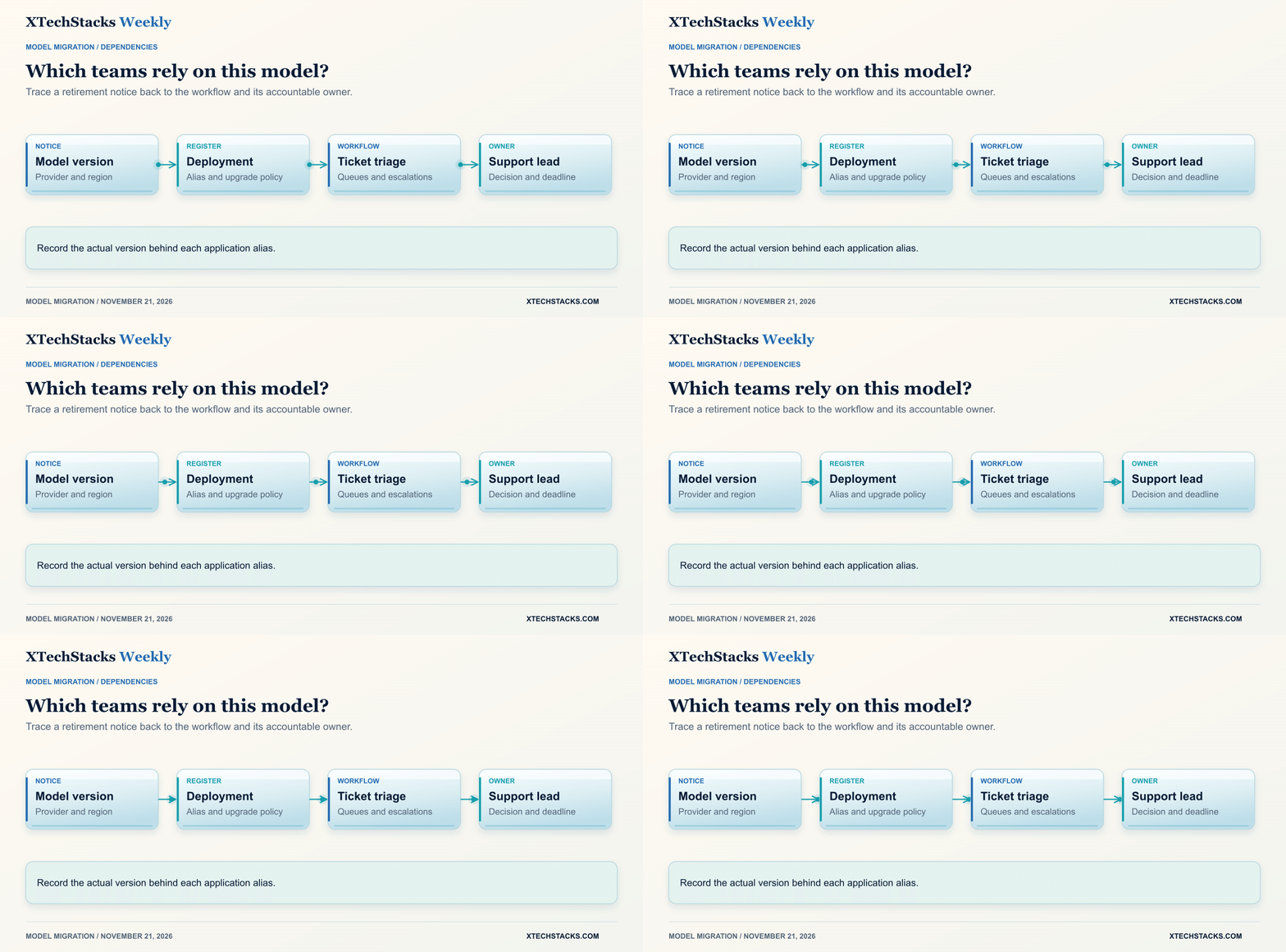
A useful dependency record should identify:
- Application and accountable owner.
- Provider, hosting platform, model ID, and version.
- Deployment region and service tier.
- Business criticality and usage volume.
- Published lifecycle status and retirement date.
- Replacement candidate and migration readiness.
- Evaluation evidence and rollback or fallback options.
The precise model identifier matters.
A friendly application-level alias is useful for routing, but the platform should also record the actual model and version behind it.
For managed endpoints, the inventory should include deployment configuration and upgrade policy, not just the model family.
Lifecycle intelligence instead of calendar reminders
The second capability is continuous awareness of model lifecycle changes.
A platform team should not depend solely on someone noticing a vendor email.
Provider documentation and management APIs can often expose lifecycle status and retirement information.
For example, Microsoft's Foundry management API exposes model lifecycle and deprecation fields.
Amazon Bedrock exposes model lifecycle information through its model APIs.
Those signals can be integrated into an internal inventory and change-management process.
The objective is to create an early warning system that identifies which applications are affected and which teams must act.
The important output is not another generic notification.
It is an actionable dependency alert:
This model deployment is scheduled for retirement. These applications depend on it. These owners are responsible. This is the remaining migration window.
Application-specific evaluation
The third capability is a reusable evaluation process.
Every critical AI application should maintain a representative set of test cases.
For a financial-document application, this might include difficult extraction cases, unusual document layouts, ambiguous financial terminology, and required output formats.
For a customer-service platform, it might include common support requests, rare exceptions, multilingual interactions, and escalation decisions.
For manufacturing, it could include technical-document interpretation, approved terminology, and scenarios requiring human review.
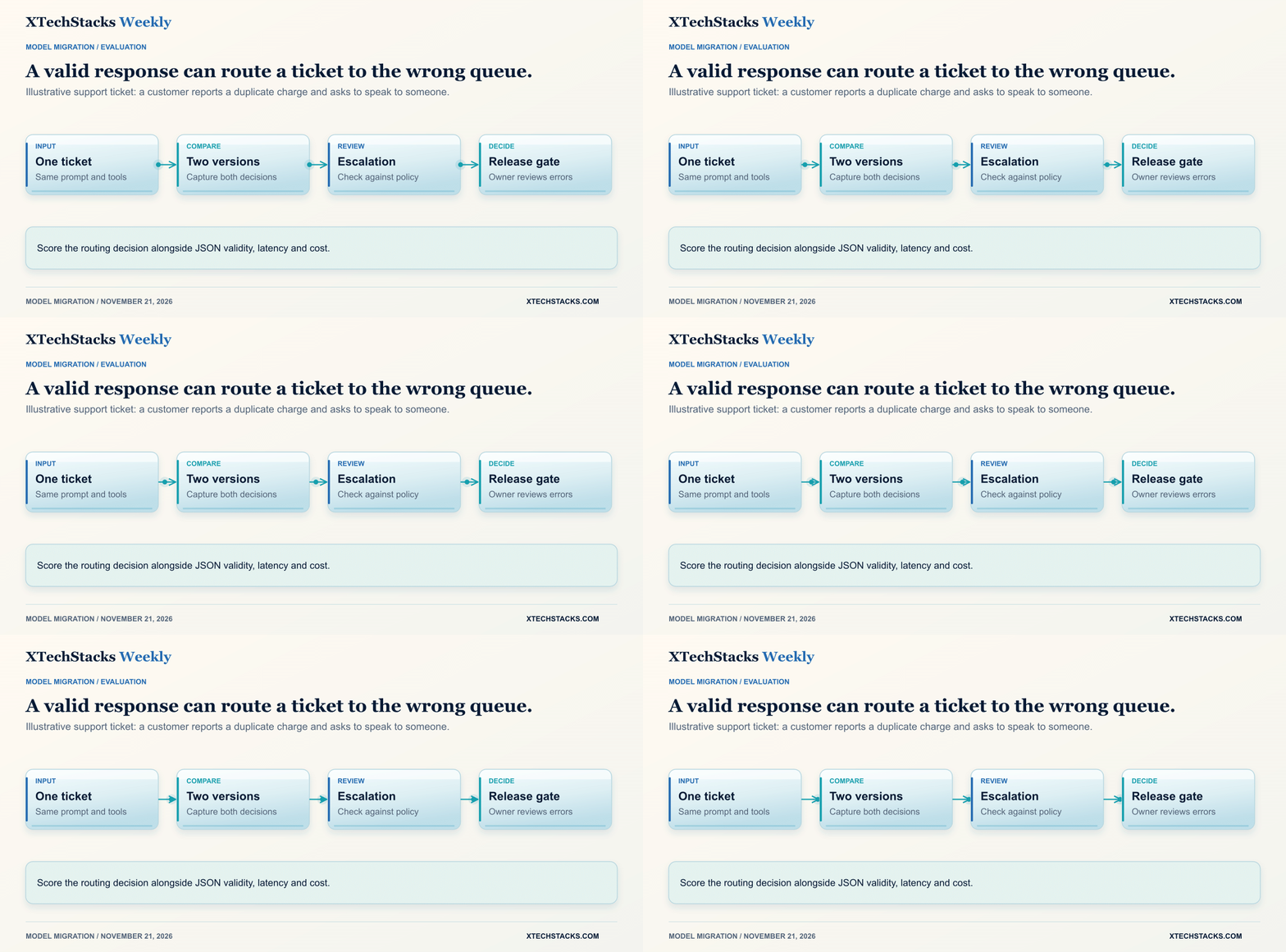
The existing and replacement models should be evaluated against the same controlled test set.
Results should include quality, error patterns, latency, operational compatibility, and cost.
For probabilistic outputs, evaluation should use appropriate task-specific metrics and expert review rather than relying exclusively on exact text matches.
The test set should be versioned, with access controls and appropriate treatment of sensitive enterprise data.
The purpose is not to prove that the new model is identical. It is to establish that the replacement is acceptable for the intended business use.
Controlled migration and rollback
The fourth capability is the ability to change the underlying model without forcing an emergency application redesign.
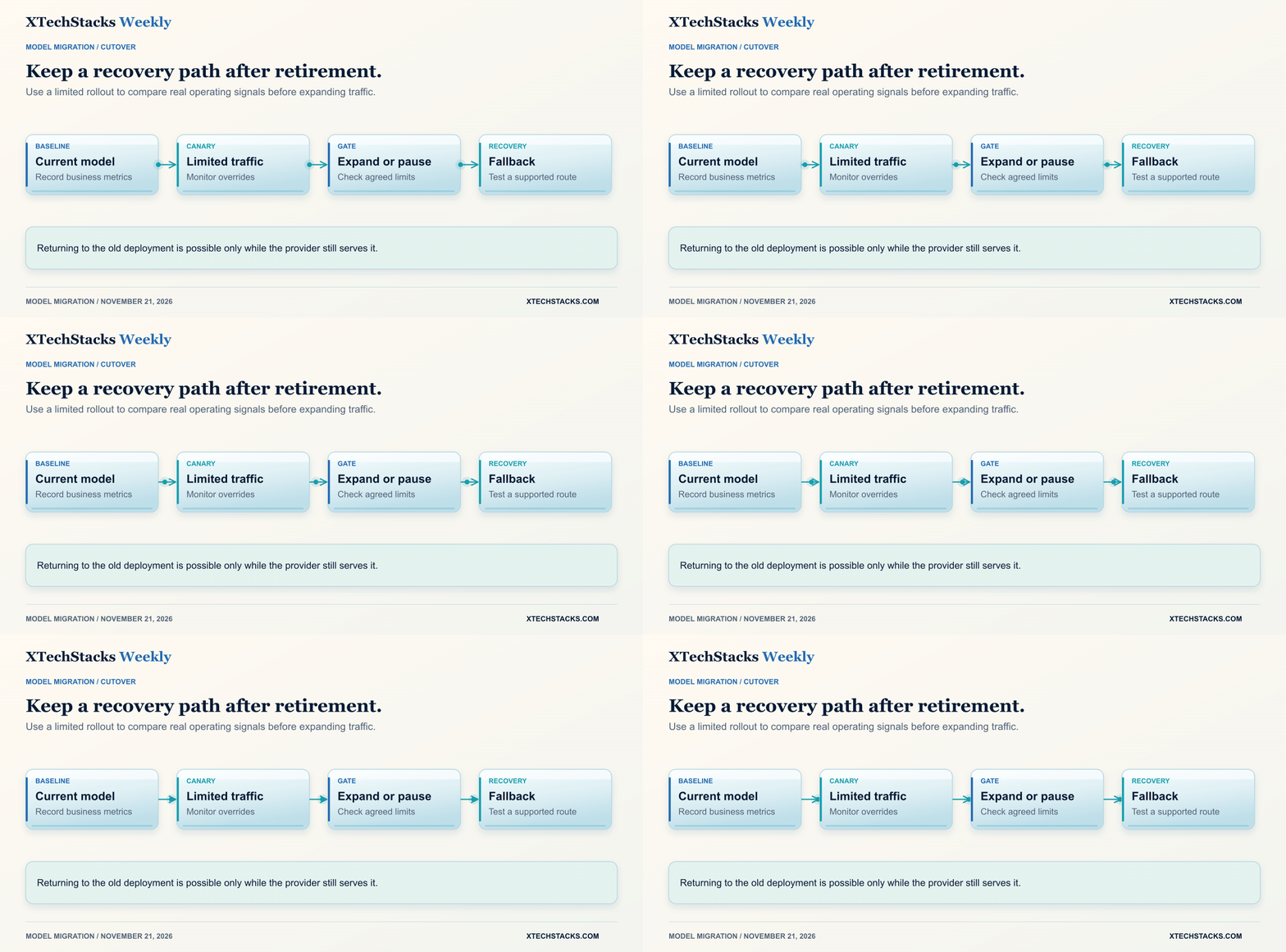
Where the provider and deployment architecture support it, use separate deployments for the current and candidate model.
Route a controlled portion of suitable traffic to the replacement.
Compare the results.
Monitor latency, error rates, output quality, cost, and operational exceptions.
Expand traffic only when the evidence supports the decision.
Maintain a rollback procedure while the original model remains available.
There is an important limit here.
Once a provider retires a model, returning to that model may no longer be possible.
A fallback must therefore be an actually supported alternative—not merely the old model ID preserved in configuration.
Rollback plans should account for that reality.
What this looks like in enterprise architecture
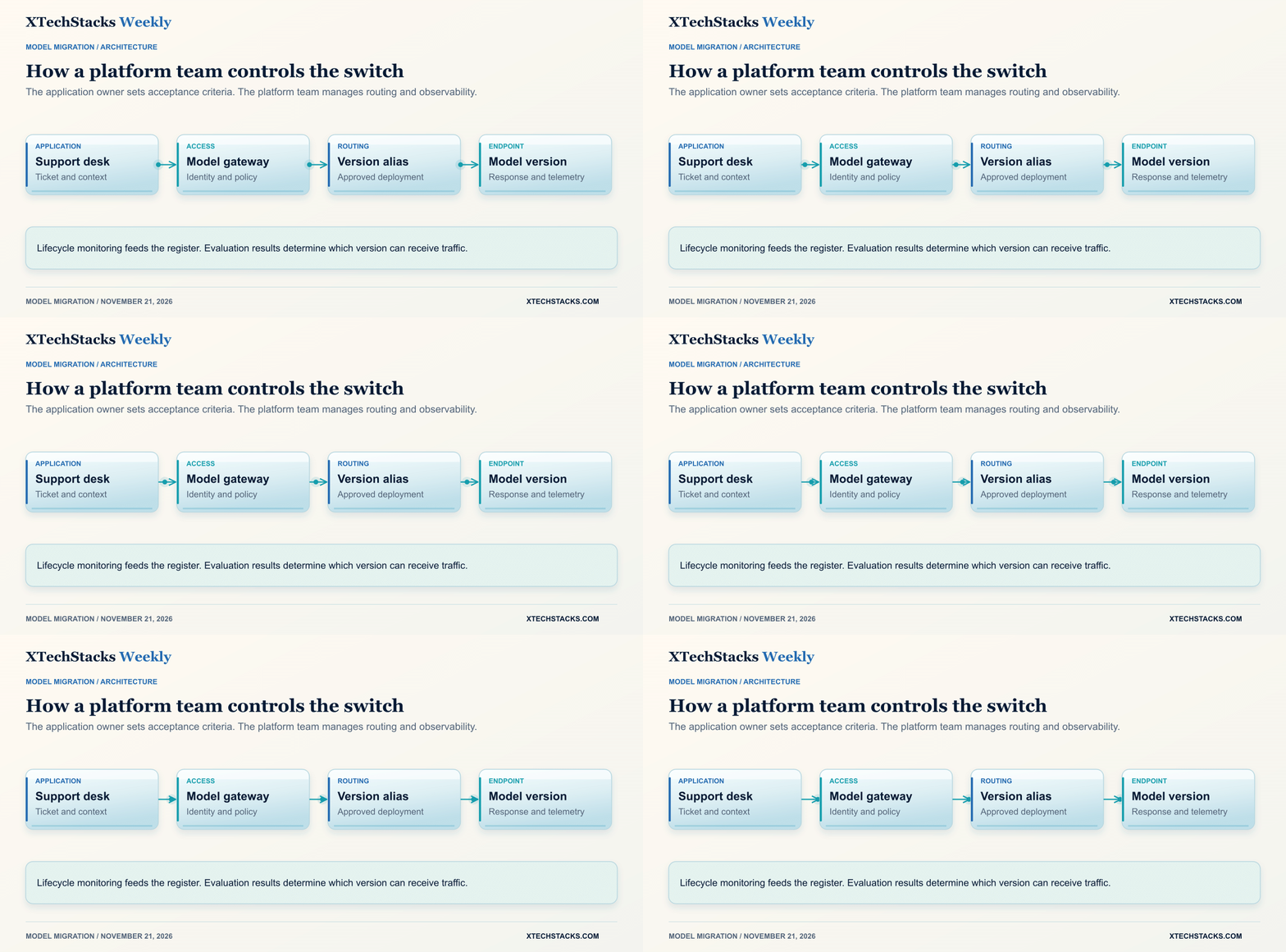
A practical model-lifecycle architecture does not require every business application to implement its own retirement monitoring and migration framework.
A shared AI platform can provide common capabilities.
Business applications
Customer support · Financial analysis · Manufacturing · Knowledge assistants · SaaS products
↓
Enterprise model access layer
Authentication · Model registry · Version resolution · Routing · Policy controls
↓
Model providers and inference endpoints
Azure OpenAI / Microsoft Foundry · Anthropic · Amazon Bedrock · Google Cloud · Self-hosted models
Alongside this request path, the platform maintains three supporting functions:
Lifecycle monitoring: Which models are active, deprecated, or scheduled for retirement?
Evaluation and release management: Which replacement versions have passed application-specific testing?
Operational observability: Did the migration change quality, latency, errors, or cost?
The architecture separates two responsibilities.
Application teams own the business requirements and approve whether a replacement meets their needs.
The central platform team owns the common inventory, routing controls, provider integrations, monitoring, and release mechanisms.
This division can reduce duplicated engineering effort while preserving accountability for business outcomes.
A centralized platform should make migrations more manageable, not remove application owners from important decisions.
The financial impact: The model migration tax
Model retirement creates a recurring form of engineering work.
For each affected application, teams may need to review compatibility, update integrations, retest prompts, evaluate quality, obtain approvals, modify configuration, and monitor production behavior.
There may also be new infrastructure requirements or changes in token consumption.
The relevant economic question is not simply whether a new model costs less per token.
It is:
How much organizational effort does it take to safely replace a model across our application portfolio?
A practical model for estimating migration cost is:
Migration cost = Engineering effort + Evaluation effort + Infrastructure/testing expense + Business review effort + Deployment and transition costs
Any resulting operating-cost changes should be assessed separately.
This distinction is important.
An expensive migration may still be worthwhile if it creates durable improvements in quality or efficiency.
A cheaper model may not be economical if it introduces substantial rework or needs repeated application changes.
And a forced migration may be necessary simply to maintain service continuity.
For SaaS companies, the risk may include product disruption and customer commitments.
For financial services, the process may require additional model-risk review and documentation.
For manufacturing organizations, model changes may affect interpretation of technical documents or operational decision support.
For mid-market businesses, even a small number of migrations can consume scarce engineering capacity.
For consulting firms, repeatable migration assessment and evaluation components can reduce project delivery effort across clients.
The commercial opportunity is not necessarily preventing model changes. It is reducing their uncertainty, disruption, and recurring engineering cost.
What I would do in the next 30 days
Start with an inventory of production AI applications and their actual model deployments.
Identify which models have announced retirement dates, which are using preview versions, and which have no documented owner.
Then prioritize the applications where disruption would be costly or where replacement options are limited.
For the highest-risk application, establish a representative evaluation dataset and test at least one supported replacement model.
Compare behavior, compatibility, latency, and cost before approving a deployment change.
Finally, document the migration process and turn it into a reusable release procedure.
Every critical production model should have an owner, a known lifecycle status, a tested migration path, and an actionable contingency plan.
This is not a one-time cleanup project.
It should become part of the routine operation of an enterprise AI platform.
The next enterprise AI risk may already have a retirement date
Enterprise AI adoption is expanding quickly.
Organizations are building more applications on commercial foundation models.
Those models continue to improve, and new versions can bring substantial benefits.
But improvement also introduces change.
Versions are deprecated.
Provider interfaces evolve.
Deployment options change.
Costs and performance characteristics shift.
Applications that depend on those models must adapt.
The enterprises that manage these changes well will not necessarily be the ones using the newest model everywhere.
They will be the organizations that understand their dependencies, evaluate replacements systematically, and control the transition.
The goal is not complete independence from model providers.
That is rarely realistic.
The goal is to prevent model lifecycle decisions made outside the enterprise from becoming unexpected business disruptions inside it.
Your AI model may have an expiration date.
Your business capability shouldn't have to.
A question for technology leaders
If one of your production AI models were scheduled for retirement next month, would you know every application that depends on it—and how long those applications would need to migrate safely?
I'd be interested in hearing how platform teams are managing model changes across their growing AI portfolios.
— XTechStacks
Technology · AI · Strategy · Impact