
View the static cover. All diagrams include static alternatives.
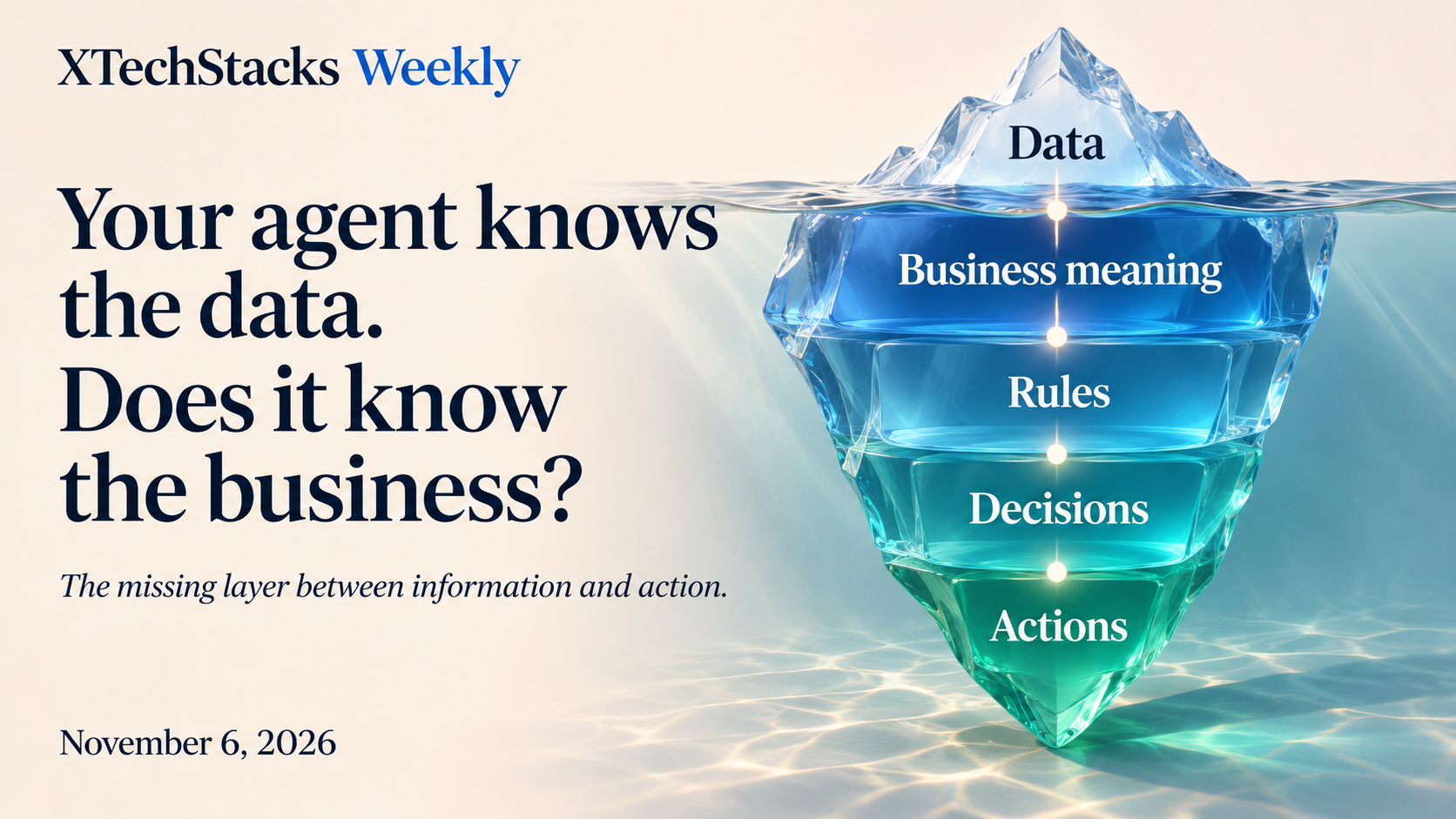
XTechStacks Weekly | November 6, 2026
Imagine an AI agent supporting procurement at a manufacturing company.
A supplier sends an invoice for $85,000.
The agent retrieves the purchase order, confirms the supplier exists in the ERP system, checks the contract, and validates the invoice amount.
Everything matches.
It recommends payment.
But the invoice should not be paid.
Why?
Because the goods have not passed quality inspection.
The purchase order is valid. The invoice is accurate. The supplier is approved.
Yet the company's operating policy requires quality acceptance before payment can proceed.
The agent had the right data. It lacked the right understanding of the business process.
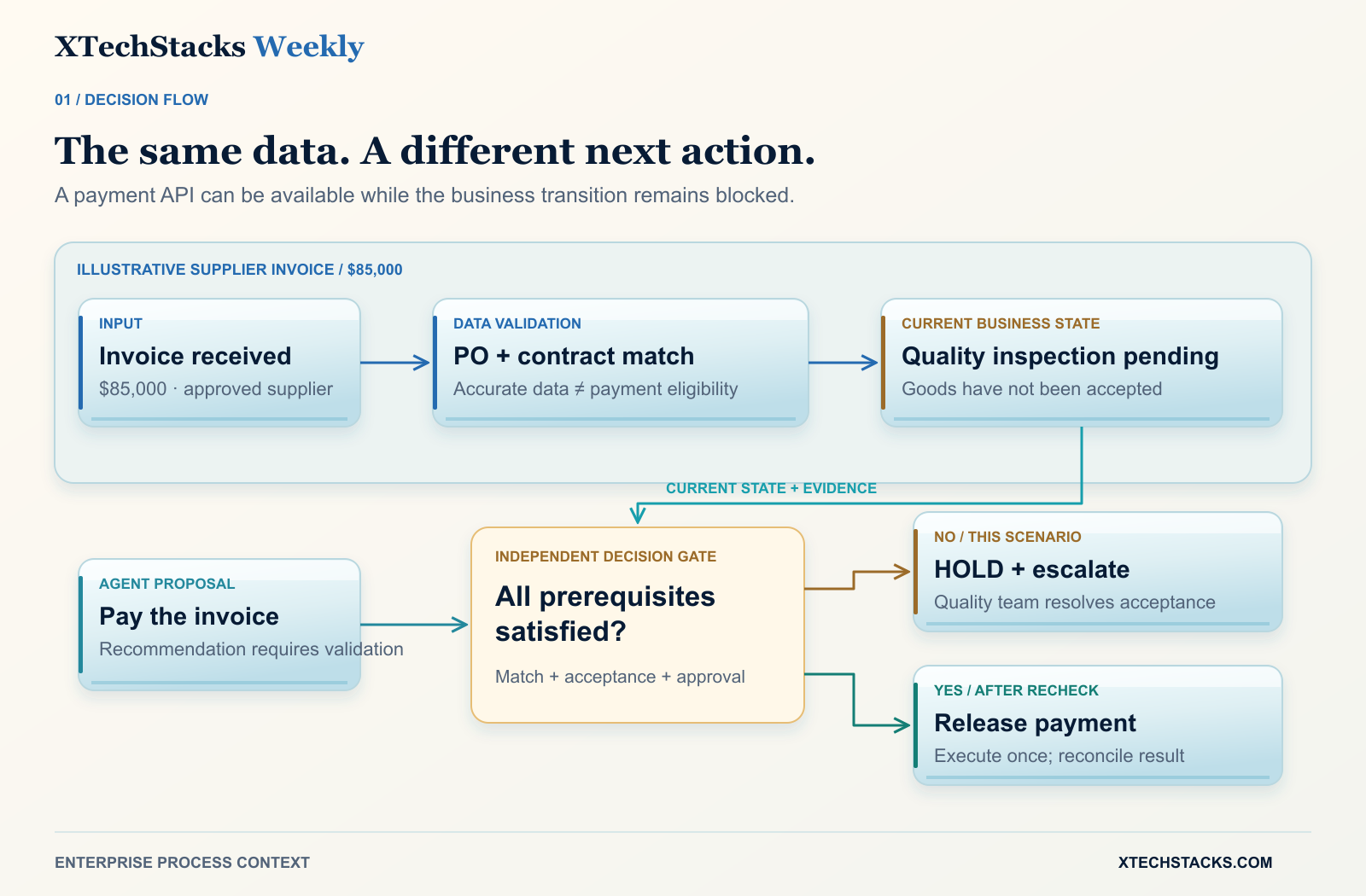
This is an illustrative scenario, but it exposes a problem that will become increasingly important as organizations give AI agents more operational responsibility.
We have invested heavily in connecting AI to enterprise information.
We are still learning how to connect AI to the way businesses actually work.
And those are not the same thing.
Data access is not operational understanding
Enterprise AI architecture has made significant progress.
Retrieval-augmented generation gives models access to documents and knowledge bases.
Tool integrations allow agents to interact with APIs, databases, and business applications.
Semantic layers help standardize business definitions.
Knowledge graphs connect entities and relationships.
These are important capabilities.
But none, by itself, guarantees that an agent understands the conditions under which a business action should occur.
Consider a procurement process.
An agent may know what a supplier is, what a purchase order contains, and how to retrieve an invoice.
It may still lack the operational context needed to determine:
- Whether goods have been received and accepted.
- Which approval path applies to this transaction.
- Whether the supplier is under a temporary payment hold.
- Which exceptions require human intervention.
- Whether a previous payment attempt has already occurred.
- What must be recorded before the transaction is considered complete.
These are not merely facts stored in documents.
They are relationships between business states, decisions, policies, people, and systems.
An enterprise process is not just a collection of data. It is a sequence of decisions governed by conditions and consequences.
An agent that lacks those conditions may generate a technically valid action at the wrong point in the process.
Why this matters now
On September 30, 2026, Gartner published research titled AI Agents Will Reengineer Operations Through Business Process Context.
Its central argument is that as agentic capabilities become more widely available, differentiation increasingly depends on capturing decision traces and embedding business-process knowledge into the context available to agents.
That is an important architectural shift.
The question is moving from:
Can the agent access the information?
To:
Does the agent understand the operational situation well enough to recommend or perform the correct action?
McKinsey's 2026 State of AI survey provides another useful signal.
The survey reports that 37% of respondents attribute at least some enterprise-level EBIT impact to AI, while AI high performers account for about 6% of respondents.
These survey findings describe reported outcomes; they do not establish that workflow redesign alone causes better financial performance.
But they reinforce an important principle.
Enterprise AI value depends on how intelligence is integrated into operations, not simply how much intelligence is deployed.
This matters for CIOs, CTOs, Heads of AI, and business leaders because the next wave of AI investment will increasingly involve actions with real operational consequences.
An incorrect answer can be corrected.
An incorrect payment, shipment, customer update, or production decision may require substantial recovery effort.
What companies are getting wrong
1. Treating RAG as a complete enterprise context strategy
Retrieval is valuable for finding relevant information.
But a retrieved policy document may be outdated, incomplete, or applicable only to a specific business unit.
A model may correctly summarize a policy while failing to determine whether that policy applies to the current transaction.
Enterprise process context requires more than document retrieval.
It needs authoritative rules, current system state, versioned policies, and explicit decision boundaries.
2. Assuming API connectivity creates process intelligence
Connecting an agent to SAP, Salesforce, ServiceNow, or a custom application gives it technical capabilities.
It does not automatically explain when those capabilities should be used.
An API might allow an invoice to be approved.
That does not mean the invoice is eligible for approval.
A permitted API operation is not necessarily an appropriate business action.
3. Capturing the happy path but ignoring exceptions
Many automation projects document a straightforward sequence:
Receive request → Validate information → Execute action → Confirm completion.
Real business processes are more complicated.
A supplier may be blocked.
An approval threshold may change.
A quality inspection may fail.
A customer may have multiple active contracts.
An exception may require escalation to a specific department.
These conditions often determine whether automation creates value or generates expensive rework.
4. Leaving business rules buried in applications and people's knowledge
Critical operational knowledge is frequently distributed across ERP configuration, workflow engines, spreadsheets, policy documents, and experienced employees.
No single system contains the complete picture.
This makes it difficult for an agent to distinguish a documented business rule from an informal practice or an outdated exception.
Organizations need to identify authoritative sources and make critical decision rules explicit.
5. Evaluating agent answers instead of process decisions
An agent may correctly extract invoice fields and accurately summarize a contract.
Those results do not establish that its payment recommendation was appropriate.
Evaluation should examine whether the agent selected the correct next action given the actual business state.
For process-oriented agents, the evaluation question must include:
Was this the right action, at the right time, under the right business conditions?
The missing layer: Enterprise Process Context
I believe enterprises need a more explicit process-context capability between their data and AI execution layers.
This does not mean replacing existing ERP, CRM, BPM, or workflow systems.
Those systems should remain authoritative for the states and decisions they own.
The opportunity is to make relevant process knowledge accessible to AI in a consistent, verifiable form.
Consider five elements.
Business entities: Suppliers, customers, invoices, orders, products, contracts, and other objects involved in a process.
Process states: Requested, validated, approved, blocked, fulfilled, paid, closed, or other domain-specific conditions.
Decision rules: Approval thresholds, prerequisites, exceptions, segregation-of-duties requirements, and business constraints.
Relationships and dependencies: Which entities, events, approvals, and system states affect one another.
Decision evidence: The source information, policy version, state snapshot, and authorization supporting a recommended action.
Together, these elements create an operational representation of the business.
An AI agent can use this representation to reason about a task.
But the authoritative workflow engine and policy controls should still determine whether consequential actions are permitted.
This separation is essential.
AI can help interpret a business situation. It should not invent the rules that govern it.
A practical framework: Discover → Model → Ground → Enforce → Verify
I would approach enterprise process intelligence through five connected capabilities.
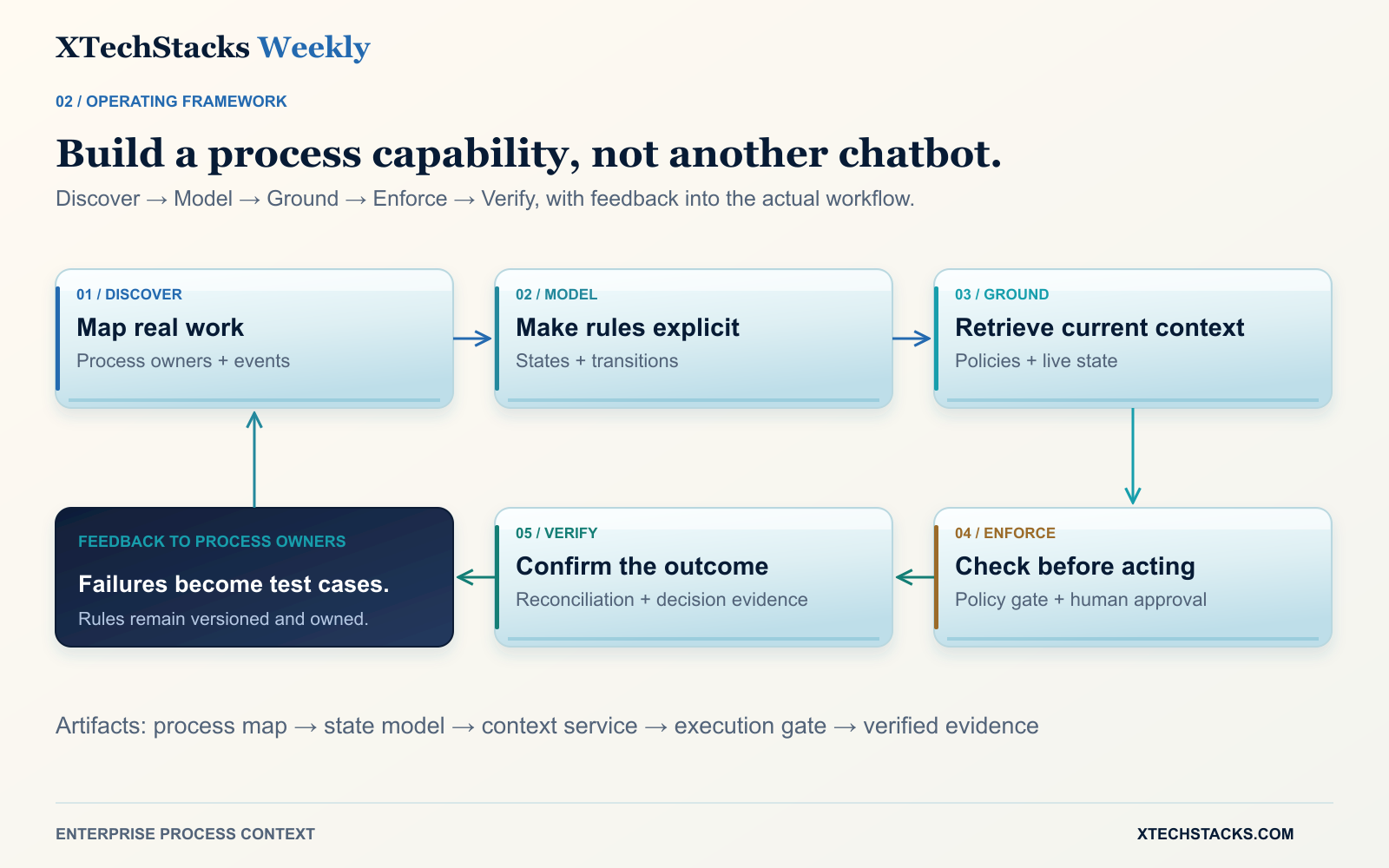
1. DISCOVER — Map the actual process
Start with a real business workflow.
Identify the systems, teams, entities, decisions, and exceptions involved.
Use process documentation, workflow definitions, system events, operational interviews, and process-mining evidence where available.
The goal is not to produce another theoretical process diagram.
It is to understand how work actually moves through the organization.
For invoice processing, map the path from invoice receipt through matching, inspection, approval, payment, and reconciliation.
Pay particular attention to exception paths.
Deliverable: An evidence-backed process map with owners, system boundaries, and known exceptions.
2. MODEL — Represent the business context
Translate the discovered process into an explicit operational model.
Define entities, relationships, states, permitted transitions, decision rules, and escalation conditions.
For example:
An invoice may move from validated to eligible for payment only when required matching, quality acceptance, and approval conditions have been satisfied.
Some rules can be represented in existing workflow engines or decision tables.
Other relationships may benefit from a semantic model or knowledge graph.
A graph is useful when relationships are complex, but it is not mandatory.
Deliverable: A versioned process-context model linked to authoritative business systems.
3. GROUND — Give agents current, authoritative context
When an agent receives a request, provide the relevant business context rather than a large, unfiltered collection of documents.
The context should include the current transaction state, applicable policy version, relevant dependencies, and source references.
If the agent is evaluating an invoice, it should know whether goods were accepted, whether payment is blocked, and whether the approval chain is complete.
If a required fact is missing or stale, the agent should identify the uncertainty rather than assume the favorable condition.
Deliverable: Context retrieval that combines trusted information with current operational state.
4. ENFORCE — Keep decisions within business boundaries
Before executing a consequential action, validate the proposed transition against authoritative rules.
An agent may recommend payment.
A deterministic control should check whether payment prerequisites are satisfied.
For high-risk actions, the system may require human approval.
Permissions, policy checks, segregation of duties, and transaction controls should be enforced outside the agent's own reasoning.
This avoids making a probabilistic model the final authority for critical business decisions.
Deliverable: An independently enforced decision and execution boundary.
5. VERIFY — Confirm the business outcome
After execution, validate the resulting system state.
Did the payment occur exactly once?
Was the correct supplier paid?
Did the invoice reach the appropriate status?
Was the approval evidence preserved?
Did any downstream reconciliation fail?
Record the decision evidence and use confirmed failures to improve the process model and regression tests.
Deliverable: A verified business outcome, not merely a successful tool response.
What the architecture could look like
A practical implementation can reuse existing enterprise infrastructure.
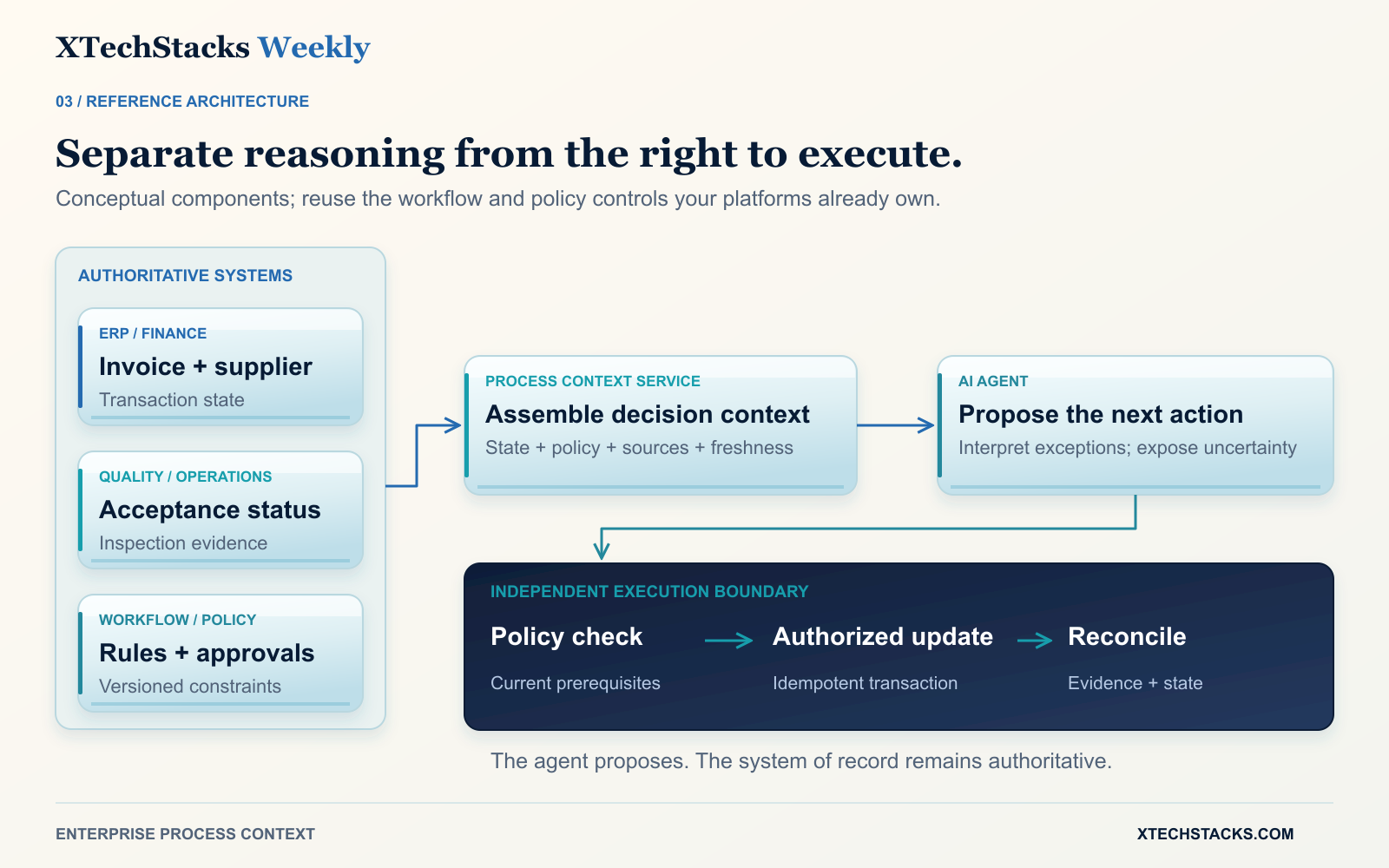
Enterprise systems
ERP · CRM · Procurement · Finance · Manufacturing · SaaS applications
↓
Operational context services
Process definitions · Business rules · Current states · Entity relationships · Policy versions
↓
AI reasoning and orchestration
Retrieval · Tool selection · Exception interpretation · Recommended next action
↓
Independent execution controls
Authorization · Policy evaluation · Workflow transitions · Human approval
↓
Business systems of record
Authorized updates · Transactions · Audit events
↓
Outcome verification
State reconciliation · Exception detection · Decision evidence · Regression feedback
The architecture should be designed around existing enterprise systems rather than creating a second, competing source of truth.
A company already using Microsoft Azure might combine managed identities, API Management, workflow services, event-driven integrations, and its existing business applications with a lightweight process-context service.
A company using SAP, Salesforce, or ServiceNow should leverage the workflow and policy capabilities already available in those platforms.
The important architectural decision is not which LLM or graph database to select first.
It is where the authoritative business rules live and how agents obtain and respect them.
The economics: Why process context can pay for itself
Consider an illustrative mid-market organization processing 12,000 supplier invoices per month.
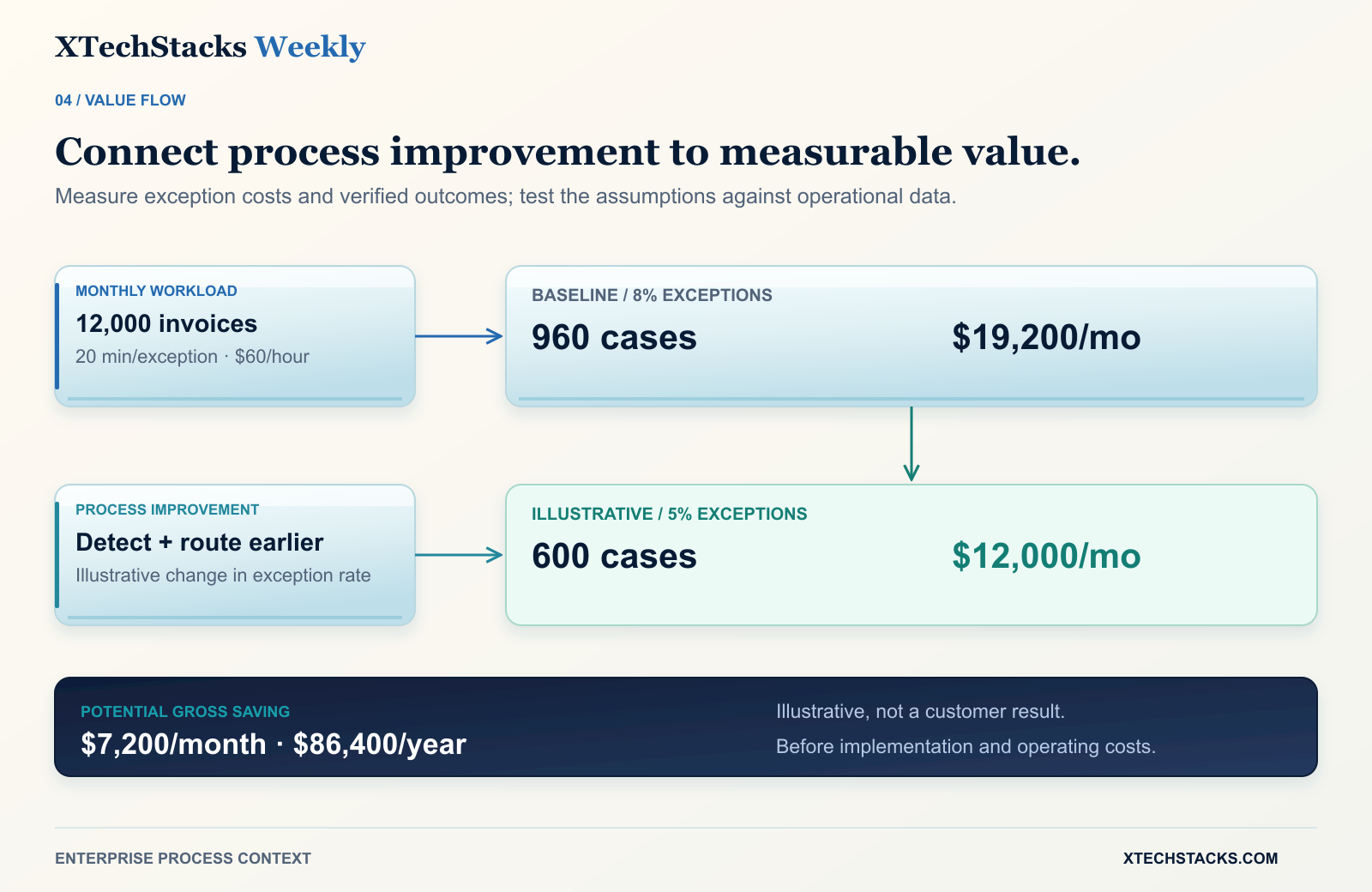
Suppose 8% of invoices require manual exception handling.
That represents 960 exceptions.
Assume each exception requires 20 minutes of staff time at a fully loaded labor cost of $60 per hour.
The monthly exception-handling cost is:
960 × 20/60 × $60 = $19,200
Now suppose improved process context, earlier exception detection, and better workflow routing reduce the exception rate from 8% to 5%.
That leaves 600 exceptions.
The monthly handling cost becomes $12,000.
The potential gross saving is:
$7,200 per month, or $86,400 annually.
This is an illustrative model, not a reported customer result.
It assumes unchanged invoice volume, handling time, and labor cost. It excludes implementation, maintenance, model usage, integration costs, and any new review workload.
The value proposition should therefore be tested against real operational data.
But the principle is important.
The economic value of process intelligence comes from reducing incorrect decisions, exceptions, delays, and rework—not from increasing the number of AI interactions.
For higher-risk workflows, avoided financial losses and improved compliance may be more important than labor savings.
Where process intelligence matters most
Manufacturing
Manufacturers coordinate procurement, production, quality inspection, inventory, and supplier management.
An AI agent needs to understand dependencies between these processes.
A purchase order may be valid while payment remains blocked by quality acceptance.
An inventory transfer may be technically possible but inappropriate because of a production hold.
Process context helps connect operational decisions to real business conditions.
Financial services
Financial workflows involve authorization, reconciliation, regulatory requirements, and transaction-state management.
An agent may retrieve accurate customer information yet still need to respect eligibility rules, approval thresholds, and exception procedures.
Here, process intelligence must be paired with strong auditability and deterministic controls.
SaaS companies
SaaS businesses increasingly use agents for customer onboarding, billing operations, support, renewals, and account management.
An agent needs to understand customer lifecycle state, contract entitlements, billing conditions, and escalation rules.
The opportunity is to reduce fragmented workflows and improve customer outcomes.
Mid-market enterprises
Mid-market organizations often rely on a mixture of ERP systems, SaaS applications, spreadsheets, and informal operating procedures.
They may not need an enterprise-wide process knowledge graph.
A focused process-context model for one high-value workflow can be more practical and economical.
Consulting organizations
Consulting firms can use process-context assessments to distinguish between workflows that are ready for AI automation and those requiring process standardization first.
The reusable value lies in discovery methods, modeling patterns, evaluation scenarios, and integration components.
Client-specific rules and ownership still require individual validation.
Five metrics that reveal whether agents understand the process
I would recommend measuring:
| Metric | What it tells leadership |
|---|---|
| Valid next-action rate | How often the agent recommends an action appropriate to the actual business state |
| Exception handling accuracy | Whether the agent correctly identifies and routes nonstandard cases |
| Policy-compliant execution rate | Whether executed actions satisfy required controls |
| Human rework rate | How frequently employees must correct agent-supported outcomes |
| Cost per verified process outcome | Whether automation produces measurable operational value |
These should be measured by workflow, exception category, and business risk.
An aggregate agent success rate may conceal serious failures in a small number of consequential transactions.
What technology leaders should do in the next 30 days
Week 1 — Select one process. Choose a workflow with recurring exceptions, measurable costs, and clear ownership.
Week 2 — Map decision points. Identify the actual conditions that determine what should happen next, including exception paths and approval requirements.
Week 3 — Test process understanding. Present representative business scenarios to the agent and compare its recommendations against decisions validated by process owners.
Week 4 — Pilot controlled execution. Allow the agent to recommend or execute a narrow set of actions through independent policy checks, then measure verified outcomes.
Do not begin with the goal of making the entire organization autonomous.
Begin by proving that one agent can make better decisions within one clearly defined business process.
The next enterprise AI advantage may be operational understanding
The first phase of enterprise AI focused heavily on model capabilities.
The next phase focused on connecting models to enterprise information and tools.
The emerging challenge is to make those capabilities useful inside real business operations.
That requires more than accurate retrieval.
It requires understanding states, dependencies, exceptions, decision rules, and consequences.
A highly capable AI agent without business-process context may be fast, articulate, and technically correct while still making the wrong operational decision.
The solution is not to abandon agents.
It is to give them the right context and surround consequential actions with reliable controls.
The next competitive advantage in enterprise AI may not be the agent that knows the most.
It may be the agent that understands what should happen next—and knows when it must not act.
A question for technology leaders
Where does your organization keep the business knowledge that determines what should happen next: in formal workflows and systems, or in the experience of employees who know how things really work?
I'd be interested in hearing which business processes are proving hardest to automate reliably.
— XTechStacks
Technology · AI · Strategy · Impact
Evidence and editorial references
The sources below support the direction without treating surveys, vendor perspectives, or research proposals as proof of universal outcomes.
Gartner — AI Agents Will Reengineer Operations Through Business Process Context, September 30, 2026. Supports the importance of decision traces and process context.
McKinsey — The State of AI, 2026. Provides survey context on reported enterprise-level AI value and the share of AI high performers.
Guidehouse — Why Context Is the Control Layer for Enterprise AI Agents, July 28, 2026. Discusses business logic, trusted data, and workflow awareness.
Camunda — State of Agentic Orchestration and Automation 2026. Survey-based context on distributed processes and operational orchestration challenges.